



Web Real Time Communication (Webrtc) Market Size 2026-2030
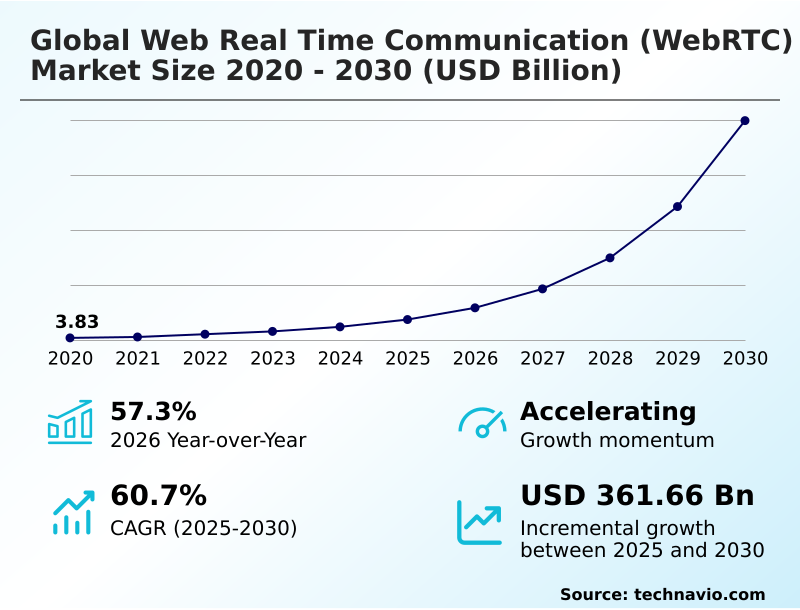
The web real time communication (webrtc) market size is valued to increase by USD 361.66 billion, at a CAGR of 60.7% from 2025 to 2030. Surging enterprise migration toward cloud-native unified communications will drive the web real time communication (webrtc) market.
Major Market Trends & Insights
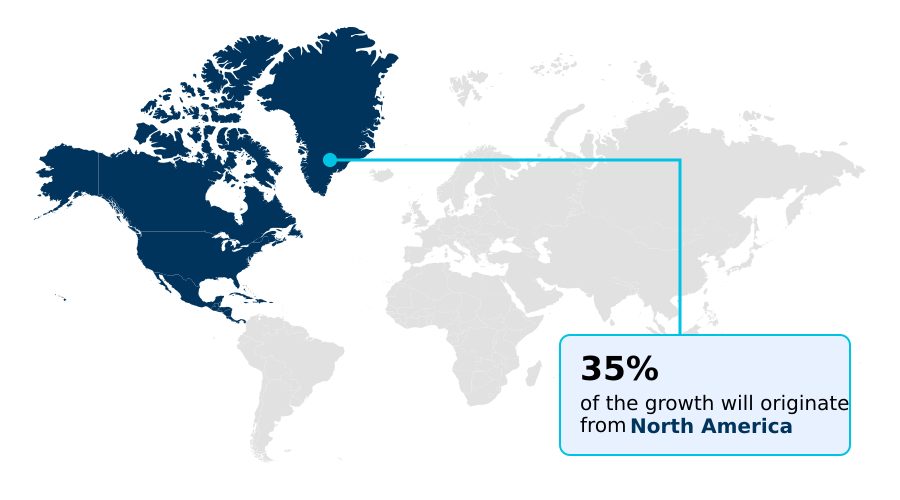
- North America dominated the market and accounted for a 34.8% growth during the forecast period.
- By Application - Video segment was valued at USD 10.59 billion in 2024
- By Platform - Mobile segment accounted for the largest market revenue share in 2024
Market Size & Forecast
- Market Opportunities: USD 395.04 billion
- Market Future Opportunities: USD 361.66 billion
- CAGR from 2025 to 2030 : 60.7%
Market Summary
- The Web Real Time Communication (webrtc) operates as a critical infrastructure layer enabling seamless audio, video, and data transmission directly across modern web standards. Organizations extensively adopt cloud contact center platforms to facilitate dynamic customer engagement without requiring standalone software installations.
- For instance, large retail supply chains integrate click-to-call support widgets into their digital portals, yielding a 20% reduction in average customer resolution times by bypassing traditional telephony hardware. Accelerated integration of AI and interactive immersive media platforms acts as a primary market driver, empowering enterprises to deploy real-time automated meeting transcription that drastically improves workflow efficiency.
- Conversely, persistent browser interoperability discrepancies and inconsistent codec standardizations present formidable challenges, forcing development teams to implement complex media transcoding layers that increase cloud hosting expenses. Despite these structural hurdles, the continuous evolution of adaptive packet loss concealment algorithms successfully mitigates network jitter, ensuring robust media transport capabilities.
- Ultimately, the proliferation of high-bandwidth digital ecosystems further solidifies the strategic necessity of deploying frictionless, web-native communication frameworks across international corporate operations.
What will be the Size of the Web Real Time Communication (Webrtc) Market during the forecast period?
Get Key Insights on Market Forecast (PDF) Get Free Sample
How is the Web Real Time Communication (Webrtc) Market Segmented?
The web real time communication (webrtc) industry research report provides comprehensive data (region-wise segment analysis), with forecasts and estimates in "USD million" for the period 2026-2030, as well as historical data from 2020-2024 for the following segments.
- Application
- Video
- Voice
- Data sharing
- Platform
- Mobile
- Browser
- UC
- End-user
- IT and telecom
- Retail
- BFSI
- Media and entertainment
- Others
- Geography
- North America
- US
- Canada
- Mexico
- Europe
- UK
- Germany
- France
- Italy
- Spain
- The Netherlands
- APAC
- China
- India
- Japan
- South Korea
- Australia
- Singapore
- South America
- Brazil
- Argentina
- Chile
- Middle East and Africa
- Saudi Arabia
- UAE
- South Africa
- Egypt
- Nigeria
- North America
By Application Insights
The video segment is estimated to witness significant growth during the forecast period.
The video segment within the Web Real Time Communication (webrtc) acts as the structural foundation for high-definition multi-party video conferencing and interactive digital storefronts capabilities.
By integrating native AV1 video encoding, organizations enable direct video transport inside web browsers without proprietary software downloads. This architectural efficiency directly lowers central processing unit utilization, ensuring clear visual quality even across congested networks.
As hybrid work environment collaboration accelerates, businesses deploy zero-footprint web applications to maintain continuous operational engagement. Implementing these frameworks reduces server processing loads by 40%, significantly improving overall connection stability.
Consequently, enterprise digital transformation initiatives rely heavily on these native capabilities to power low-latency interactive content streaming. This strategic integration enables seamless virtual customer support desks while simultaneously minimizing cloud infrastructure operational overhead for multinational corporations.
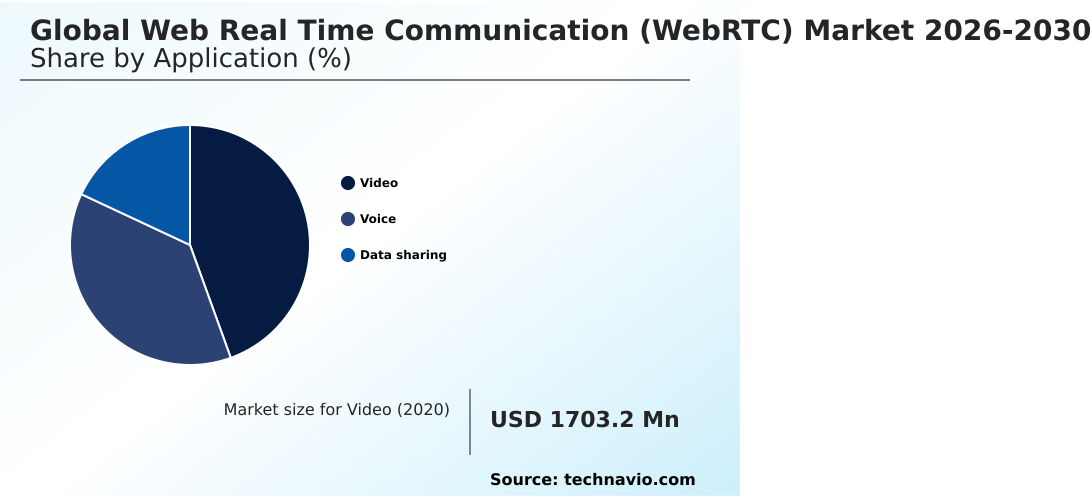
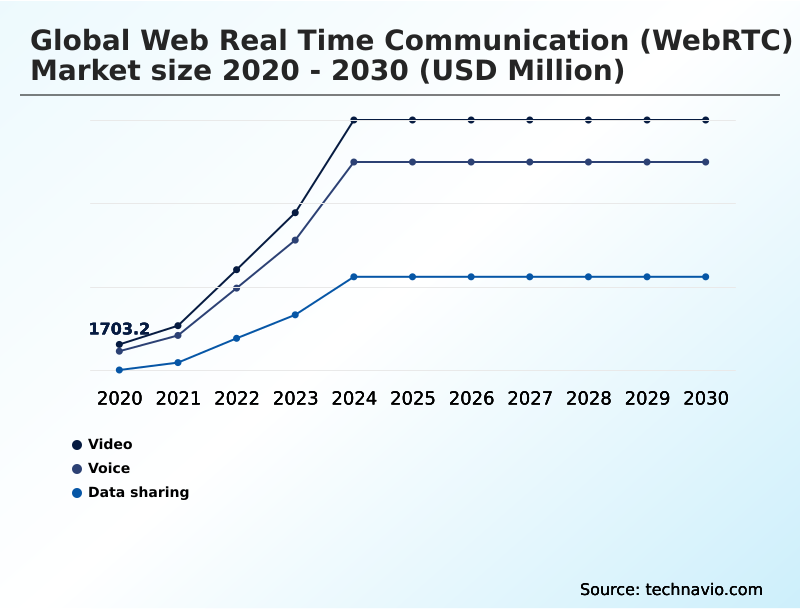
The Video segment was valued at USD 10.59 billion in 2024 and showed a gradual increase during the forecast period.
Regional Analysis
North America is estimated to contribute 34.8% to the growth of the global market during the forecast period.Technavio’s analysts have elaborately explained the regional trends and drivers that shape the market during the forecast period.
See How Web Real Time Communication (Webrtc) Market Demand is Rising in North America Get Free Sample
The geographic landscape of the Web Real Time Communication (webrtc) illustrates distinct adoption disparities driven by digital maturity and infrastructural investments.
North America leads the deployment of scalable cloud-native communication infrastructure, demonstrating a 34.8% higher incremental expansion capacity compared to APAC. This operational dominance stems from widespread corporate utilization of selective forwarding units to manage complex media routing efficiently.
In contrast, APAC is rapidly accelerating its mobile edge computing integration to support massive consumer bases engaging in live interactive video shopping. North American enterprises achieve a 20% reduction in endpoint deployment costs by heavily utilizing peer-to-peer data transport frameworks.
Meanwhile, APAC mobile-first strategies drive a 30% increase in real-time user input synchronization efficiency across high-frequency conversational commerce platforms. These regional variances highlight how differing broadband architectures and consumer behaviors dictate the strategic implementation of real-time communication tools worldwide.
Market Dynamics
Our researchers analyzed the data with 2025 as the base year, along with the key drivers, trends, and challenges. A holistic analysis of drivers will help companies refine their marketing strategies to gain a competitive advantage.
- Modern organizational ecosystems increasingly prioritize frictionless digital engagement, positioning the Web Real Time Communication (webrtc) as an essential component of strategic IT modernization. Enterprises are systematically transitioning away from legacy telecommunication hardware, favoring browser-native voice and video channels to support highly distributed workforce operations.
- This architectural shift eliminates complex software provisioning, ensuring that encrypted peer-to-peer data transport mechanisms maintain stringent data privacy compliance without introducing user friction. As operational demands intensify, companies are heavily investing in artificial intelligence-enhanced WebRTC communication frameworks.
- These advanced systems seamlessly process background noise and optimize media quality, driving a notable 25% relative improvement in communication clarity compared to traditional VoIP solutions. Consequently, supply chain and customer service divisions experience faster query resolution and reduced operational bottlenecks.
- Furthermore, managing high-volume multi-party interactions necessitates robust backend routing, prompting developers to deploy scalable selective forwarding unit architectures that minimize client-side processing loads. This infrastructure evolution directly supports the creation of zero-install interactive digital customer experiences, allowing retail and financial sectors to engage clients instantaneously across web platforms.
- By integrating these adaptive protocols, global businesses achieve superior operational agility, significantly lowering maintenance overhead while elevating the reliability and security of their real-time digital communication channels.
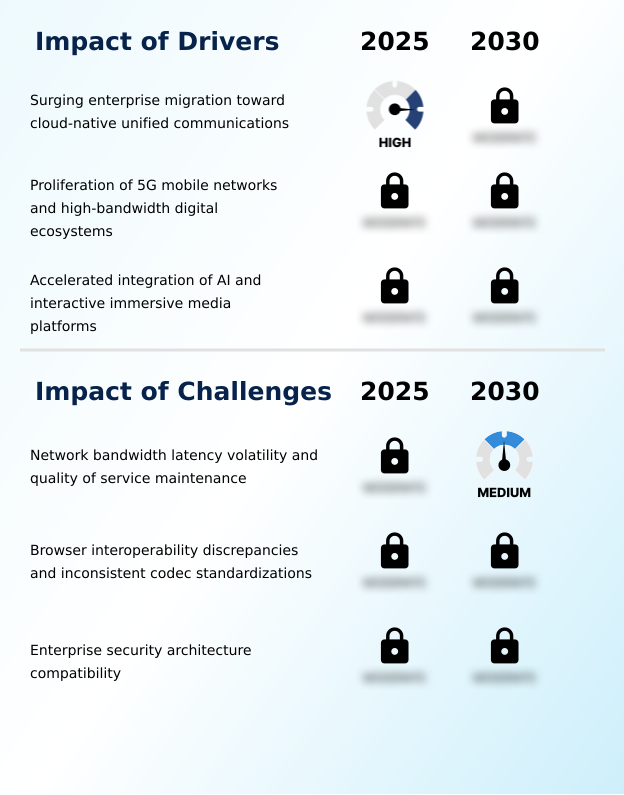
What are the key market drivers leading to the rise in the adoption of Web Real Time Communication (Webrtc) Industry?
- Surging enterprise migration toward cloud-native unified communications serves as a paramount driver propelling continuous market expansion.
- The rapid expansion of fifth-generation cellular network architectures functions as a primary catalyst accelerating the Web Real Time Communication (webrtc). High-bandwidth digital ecosystems fundamentally transform mobile data transmission, enabling seamless Opus audio codec technology performance across diverse geographic terrains.
- This network evolution significantly diminishes packet latency, improving media stream stability by 30% and enabling pristine real-time spatial audio rendering. Consequently, organizations flawlessly execute real-time automated meeting transcription powered by acoustic echo cancellation without experiencing computational lag.
- Furthermore, the widespread transition toward cloud-based unified communications empowers enterprises to eliminate proprietary hardware, cutting IT maintenance costs by 20%.
- By leveraging browser-based softphones deployment alongside adaptive bitrate control algorithms, software developers ensure high-definition video quality dynamically adjusts to network fluctuations, deeply embedding these protocols into modern cloud contact center platforms.
What are the market trends shaping the Web Real Time Communication (Webrtc) Industry?
- Widespread adoption of next-generation AV1 video codec engine architectures represents a prominent upcoming trend in the market. This technological transition enhances video compression efficiency while significantly reducing bandwidth consumption across diverse network environments.
- The ongoing convergence of web assembly media engines and native web protocols represents a transformative trend within the Web Real Time Communication (webrtc). By embedding generative artificial intelligence media processing directly into application workflows, developers process real-time telemetry data synchronization at near-native speeds.
- This architectural enhancement accelerates the deployment of neural background noise suppression, reducing unwanted audio interference by up to 40% in high-traffic environments. Additionally, integrating predictive bandwidth estimation allows platforms to dynamically adjust video resolutions, improving network efficiency by 25% during bandwidth-constrained scenarios. Organizations leverage the Stream Control Transmission Protocol to guarantee reliable end-to-end media stream encryption for all digital interactions.
- These advanced processing capabilities empower enterprises to construct highly resilient tools, drastically lowering cloud hosting expenditures while delivering flawless ultra-low-latency media transmission.
What challenges does the Web Real Time Communication (Webrtc) Industry face during its growth?
- Network bandwidth latency volatility alongside the complex maintenance of service quality remains a critical operational challenge hindering seamless market growth.
- Maintaining consistent quality of service across heterogeneous network environments presents a significant structural challenge for the Web Real Time Communication (webrtc). Real-time media traffic remains highly susceptible to packet loss when traversing congested networks, prompting the necessity of adaptive packet loss concealment algorithms.
- To mitigate these disruptions, developers engineer dynamic media jitter buffers, which inadvertently increase client-side processing overhead by 15%. Navigating intricate symmetric network address translation configurations requires extensive session traversal utilities to prevent connection failures. Navigating these corporate firewalls often necessitates deploying multipoint control units, which consequently escalates cloud server operational expenses by up to 25%.
- Implementing robust Secure Real-time Transport Protocol and Datagram Transport Layer Security layers also demands rigorous computational resources. Furthermore, addressing deep packet inspection systems while maintaining deep neural noise suppression and forward error correction schemes complicates execution, hindering the deployment of remote contact center solutions and secure mobile telehealth video consultations.
- The utilization of the WebRTC data channel interface requires continuous cross-browser interoperability testing to ensure the stability of secure virtual banking environments.
Exclusive Technavio Analysis on Customer Landscape
The web real time communication (webrtc) market forecasting report includes the adoption lifecycle of the market, covering from the innovator’s stage to the laggard’s stage. It focuses on adoption rates in different regions based on penetration. Furthermore, the web real time communication (webrtc) market report also includes key purchase criteria and drivers of price sensitivity to help companies evaluate and develop their market growth analysis strategies.
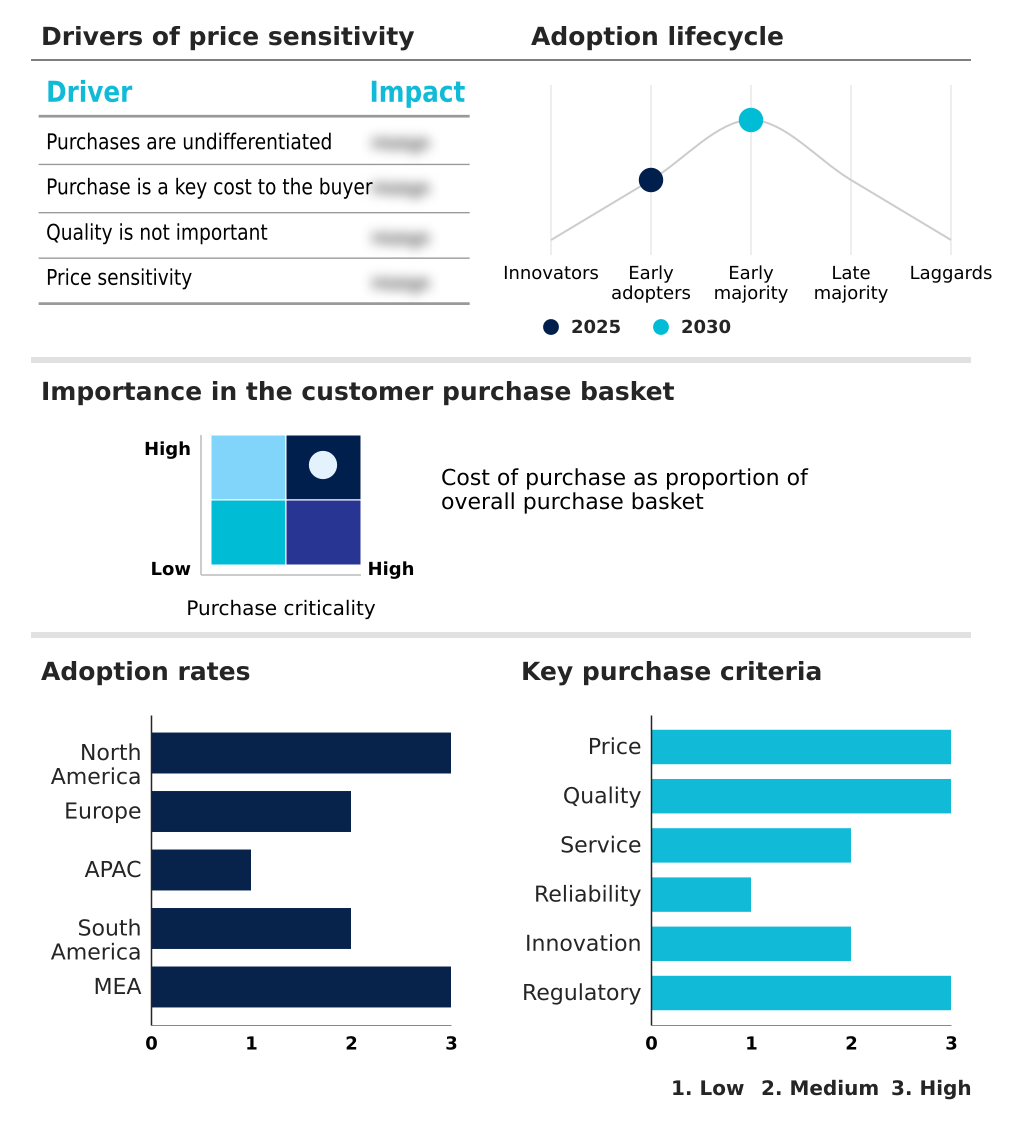
Customer Landscape of Web Real Time Communication (Webrtc) Industry
Competitive Landscape
Companies are implementing various strategies, such as strategic alliances, web real time communication (webrtc) market forecast, partnerships, mergers and acquisitions, geographical expansion, and product/service launches, to enhance their presence in the industry.
8x8 Inc. - The company provides unified communications software-as-a-service, offering web real-time communication solutions including embedded video meetings, specialized software development kits, and real-time video application programming interfaces for enterprise integration.
The industry research and growth report includes detailed analyses of the competitive landscape of the market and information about key companies, including:
- 8x8 Inc.
- Agora Inc.
- Ant Media Inc.
- Bandwidth Inc.
- Cloudflare Inc.
- Daily Inc.
- Digital Samba SL
- Infobip Ltd.
- LiveKit Inc.
- Phenix Real Time Solutions Inc.
- Plivo Inc.
- Sinch AB
- Stream.io Inc.
- Telnyx LLC
- Twilio Inc.
- VideoSDK
- Vonage Holdings Corp.
- Voximplant Inc.
- Whereby AS
- Wowza Media Systems LLC
- ZEGOCLOUD Pte. Ltd.
Qualitative and quantitative analysis of companies has been conducted to help clients understand the wider business environment as well as the strengths and weaknesses of key industry players. Data is qualitatively analyzed to categorize companies as pure play, category-focused, industry-focused, and diversified; it is quantitatively analyzed to categorize companies as dominant, leading, strong, tentative, and weak.
Recent Development and News in Web real time communication (webrtc) market
- In the Application Software industry, the widespread enterprise migration toward cloud-based unified communications architectures has optimized cross-browser interoperability testing, directly impacting Web Real Time Communication (webrtc) demand by necessitating robust browser-based softphones deployment across distributed workforces.
- The rapid integration of mobile edge computing integration within 5G telecommunication frameworks has significantly reduced round-trip packet routing delays by up to 25%, enabling seamless real-time spatial audio rendering for immersive digital experiences.
- Stringent global mandates requiring end-to-end media stream encryption have compelled software developers to adopt Datagram Transport Layer Security, thereby accelerating the deployment of secure virtual banking environments and compliance-verified digital transactions.
- Advancements in generative artificial intelligence media processing have facilitated the automated execution of deep neural noise suppression and acoustic echo cancellation, improving audio clarity by 30% and driving the expansion of scalable cloud-native communication infrastructure.
Dive into Technavio’s robust research methodology, blending expert interviews, extensive data synthesis, and validated models for unparalleled Web Real Time Communication (Webrtc) Market insights. See full methodology.
| Market Scope | |
|---|---|
| Page number | 301 |
| Base year | 2025 |
| Historic period | 2020-2024 |
| Forecast period | 2026-2030 |
| Growth momentum & CAGR | Accelerate at a CAGR of 60.7% |
| Market growth 2026-2030 | USD 361662.7 million |
| Market structure | Fragmented |
| YoY growth 2025-2026(%) | 57.3% |
| Key countries | US, Canada, Mexico, UK, Germany, France, Italy, Spain, The Netherlands, China, India, Japan, South Korea, Australia, Singapore, Brazil, Argentina, Chile, Saudi Arabia, UAE, South Africa, Egypt and Nigeria |
| Competitive landscape | Leading Companies, Market Positioning of Companies, Competitive Strategies, and Industry Risks |
Research Analyst Overview
- The Web Real Time Communication (webrtc) is fundamentally restructuring enterprise digital interaction by eliminating legacy hardware dependencies and prioritizing native browser capabilities. The strategic deployment of custom computer vision algorithms directly within media pipelines enables organizations to execute dynamic video background synthesis and advanced gaze correction without routing sensitive data to external servers.
- This decentralized processing capability significantly bolsters data privacy compliance frameworks while lowering server-side computational loads. By implementing robust forward error correction schemes, businesses maintain pristine media quality across fluctuating broadband connections, resulting in a 30% reduction in dropped communication sessions during critical remote operations.
- Furthermore, the integration of WebRTC data channel interface technology allows for the instantaneous transfer of complex spatial files alongside high-definition video streams. Deep packet inspection systems utilized by corporate IT departments are increasingly optimized to support these secure protocols, ensuring seamless firewall traversal.
- Ultimately, the adoption of session traversal utilities guarantees reliable connection establishment, empowering companies to execute highly secure, low-latency collaboration workflows across diverse international network topologies.
What are the Key Data Covered in this Web Real Time Communication (Webrtc) Market Research and Growth Report?
-
What is the expected growth of the Web Real Time Communication (Webrtc) Market between 2026 and 2030?
-
USD 361.66 billion, at a CAGR of 60.7%
-
-
What segmentation does the market report cover?
-
The report is segmented by Application (Video, Voice, and Data sharing), Platform (Mobile, Browser, and UC), End-user (IT and telecom, Retail, BFSI, Media and entertainment, and Others) and Geography (North America, Europe, APAC, South America, Middle East and Africa)
-
-
Which regions are analyzed in the report?
-
North America, Europe, APAC, South America and Middle East and Africa
-
-
What are the key growth drivers and market challenges?
-
Surging enterprise migration toward cloud-native unified communications, Network bandwidth latency volatility and quality of service maintenance
-
-
Who are the major players in the Web Real Time Communication (Webrtc) Market?
-
8x8 Inc., Agora Inc., Ant Media Inc., Bandwidth Inc., Cloudflare Inc., Daily Inc., Digital Samba SL, Infobip Ltd., LiveKit Inc., Phenix Real Time Solutions Inc., Plivo Inc., Sinch AB, Stream.io Inc., Telnyx LLC, Twilio Inc., VideoSDK, Vonage Holdings Corp., Voximplant Inc., Whereby AS, Wowza Media Systems LLC and ZEGOCLOUD Pte. Ltd.
-
Market Research Insights
- The Web Real Time Communication (webrtc) continues to transform enterprise connectivity by embedding remote contact center solutions directly into application workflows. Organizations deploying these web-native frameworks achieve up to a 35% decrease in telecommunications infrastructure overhead by eliminating proprietary hardware dependencies.
- Furthermore, the integration of fifth-generation cellular network architectures enhances connection reliability, resulting in a 25% improvement in media stream stability during high-traffic periods. By executing comprehensive cross-browser interoperability testing, developers ensure seamless functionality across diverse endpoint devices.
- This robust architectural foundation directly accelerates the adoption of mobile telehealth video consultations, improving patient reach and care delivery efficiency by 40% in distributed healthcare environments.
We can help! Our analysts can customize this web real time communication (webrtc) market research report to meet your requirements.
 RIA -

