
Mold Release Coatings Market Analysis, Size, and Forecast 2026-2030: APAC (China, Japan, and India), North America (US, Canada, and Mexico), Europe (Germany, UK, and France), South America (Brazil, Argentina, and Chile), Middle East and Africa (Turkey, Saudi Arabia, and UAE), and Rest of World (ROW)

Mold Release Coatings Market Analysis, Size, and Forecast 2026-2030:
APAC (China, Japan, and India), North America (US, Canada, and Mexico), Europe (Germany, UK, and France), South America (Brazil, Argentina, and Chile), Middle East and Africa (Turkey, Saudi Arabia, and UAE), and Rest of World (ROW)

Published: Nov 2026 320 Pages SKU: IRTNTR72931

Market Overview at a Glance

$331.2 Mn
Market Opportunity
5.7%
CAGR 2025 - 2030
46.9%
APAC Growth
$584.6 Mn
Water-based segment 2024

Mold Release Coatings Market Size 2026-2030

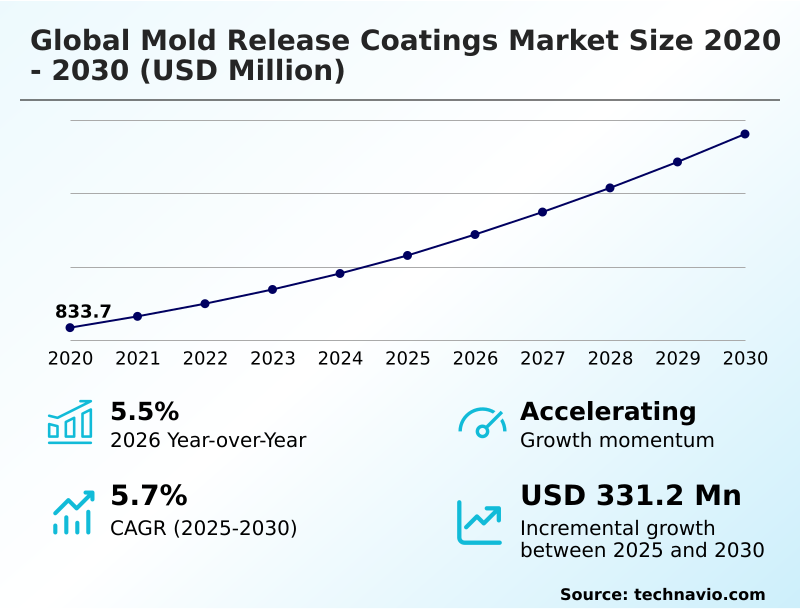
The mold release coatings market size is valued to increase by USD 331.2 million, at a CAGR of 5.7% from 2025 to 2030. Proliferation of advanced composites in automotive and aerospace industries will drive the mold release coatings market.

Major Market Trends & Insights

  • APAC dominated the market and accounted for a 46.9% growth during the forecast period.
  • By Product Type - Water-based segment was valued at USD 584.6 million in 2024
  • By Type - Semi-permanent segment accounted for the largest market revenue share in 2024

Market Size & Forecast

  • Market Opportunities: USD 528.1 million
  • Market Future Opportunities: USD 331.2 million
  • CAGR from 2025 to 2030 : 5.7%

Market Summary

  • The Mold Release Coatings Market is experiencing accelerated technological transformation driven by the mandate for high-precision manufacturing. Industrial processors increasingly rely on advanced surface barriers to prevent part adhesion, preserving both mold geometry and component integrity.
  • The proliferation of lightweight carbon-fiber composites in aerospace engineering acts as a formidable growth driver, necessitating release agents capable of enduring extreme autoclave curing environments. Conversely, the industry faces substantial formulation challenges as rigorous environmental legislation restricts the use of volatile organic compounds, compelling a complex transition toward water-based alternatives that match historical performance metrics.
  • In commercial automotive tire fabrication, optimizing the release interface has reduced scrap rates by 18%, significantly improving supply chain predictability. Automated robotic spray systems now apply micro-thin layers of active polymers, minimizing human error and chemical waste.
  • As production cycles compress, the continuous development of semi-permanent coatings that yield multiple releases per single application remains critical for sustained operational efficiency and enhanced tooling longevity.

What will be the Size of the Mold Release Coatings Market during the forecast period?
Get Key Insights on Market Forecast (PDF) Get Free Sample

How is the Mold Release Coatings Market Segmented?

The mold release coatings industry research report provides comprehensive data (region-wise segment analysis), with forecasts and estimates in "USD million" for the period 2026-2030, as well as historical data from 2020-2024 for the following segments.

  • Product type
    • Water-based
    • Solvent-based
  • Type
    • Semi-permanent
    • Sacrificial
  • Material type
    • Rubber and elastomers
    • Plastics and polymers
    • Composites
    • Others
  • End-user
    • Automotive
    • Building and construction
    • Aerospace and defense
    • Others
  • Geography
    • APAC
      • China
      • Japan
      • India
      • South Korea
      • Australia
      • Indonesia
    • North America
      • US
      • Canada
      • Mexico
    • Europe
      • Germany
      • UK
      • France
      • Italy
      • Spain
      • The Netherlands
    • South America
      • Brazil
      • Argentina
      • Chile
    • Middle East and Africa
      • Turkey
      • Saudi Arabia
      • UAE
      • South Africa
      • Egypt

By Product Type Insights

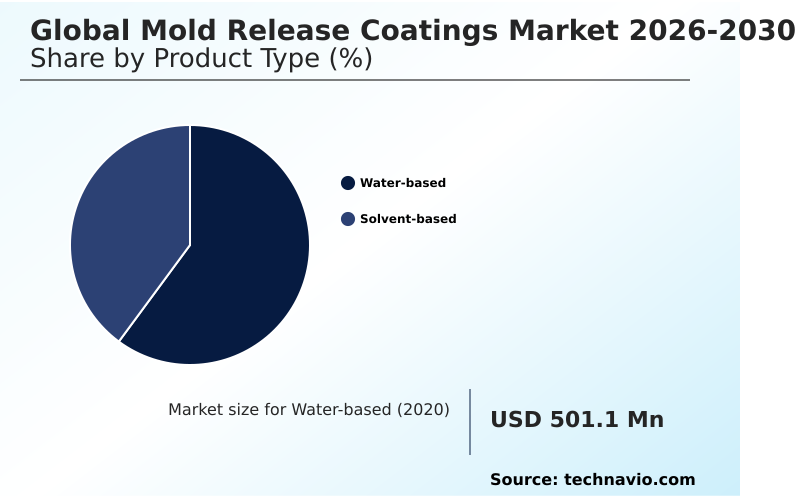
The water-based segment is estimated to witness significant growth during the forecast period.

The water-based segment within the Mold Release Coatings Market represents a critical pivot toward sustainable processing, utilizing aqueous carrier phases and emulsified siloxanes to replace hazardous solvents.

Industrial facilities adopting these formulations report that mold fouling mitigation has improved operational throughput, reducing tooling maintenance shutdowns by 15% across high-volume production lines.

These modern solutions deploy polymeric release resins that withstand high-temperature molding cycles without leaving carbonaceous deposits, ensuring clean secondary adhesive bonding. By aligning with strict occupational safety standards and volatile organic compound reduction targets, manufacturers achieve significant surface defect minimization.

The integration of electrostatic spray automation ensures uniform film formation, enhancing demolding cycle efficiency while supporting zero chemical transfer during post-cure finishing and thermoset polyurethane production.
Get Free Sample

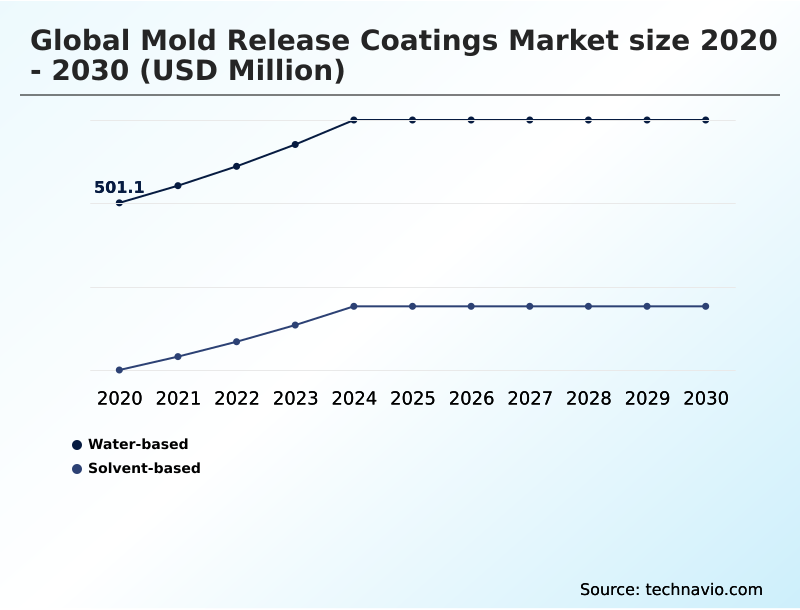
The Water-based segment was valued at USD 584.6 million in 2024 and showed a gradual increase during the forecast period.
Get Free Sample

Regional Analysis

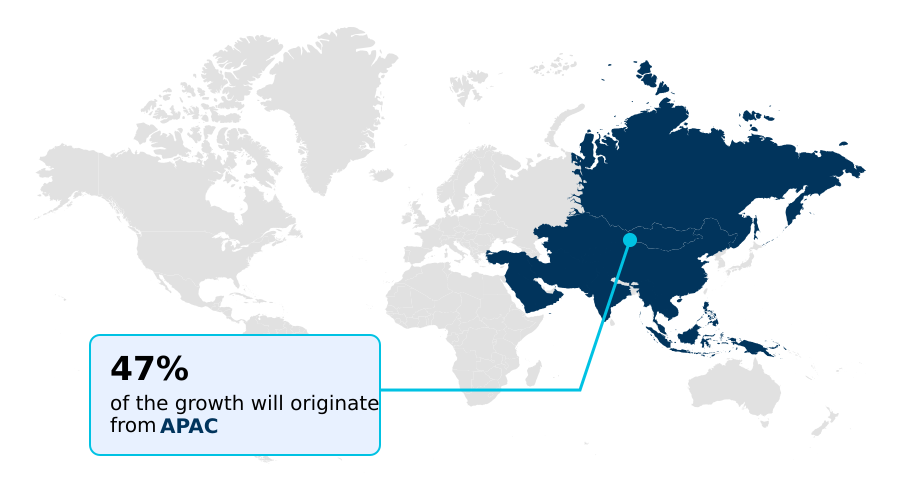
APAC is estimated to contribute 46.9% to the growth of the global market during the forecast period.Technavio’s analysts have elaborately explained the regional trends and drivers that shape the market during the forecast period.
See How Mold Release Coatings Market Demand is Rising in APAC Get Free Sample

Regional dynamics within the Mold Release Coatings Market highlight distinct adoption strategies across global manufacturing hubs.

North America emphasizes strict volatile organic compound reduction, driving a 28% higher integration of water-based epoxy resin systems compared to South America, where conventional formulations still support localized automotive assembly.

In APAC, the rapid expansion of electronics and renewable energy manufacturing requires advanced cross-linked molecular barrier solutions to endure high exothermic chemical reaction spikes.

Facilities in Europe leveraging electrostatic spray automation report a 24% improvement in tooling maintenance shutdowns, significantly enhancing overall equipment effectiveness. Furthermore, the localized shift toward sustainable bismaleimide composite processing has improved scrap rate reduction by 16% in highly regulated zones.

These geographic variations illustrate how regional compliance frameworks and automated production capabilities dictate the specialized application of synthetic siloxane chemistries and targeted mold fouling mitigation strategies.

Market Dynamics

Our researchers analyzed the data with 2025 as the base year, along with the key drivers, trends, and challenges. A holistic analysis of drivers will help companies refine their marketing strategies to gain a competitive advantage.

  • The ongoing evolution within the Mold Release Coatings Market is fundamentally reshaping manufacturing paradigms across diverse industrial sectors. By adopting a water-based silicone mold release formulation, production facilities have significantly mitigated airborne hazards while ensuring exceptional part separation. This transition allows supply chain managers to optimize procurement strategies, prioritizing environmentally compliant chemical inputs over highly regulated solvent carriers.
  • In precision engineering environments, the implementation of high pressure aluminum casting lubrication has demonstrated superior thermal resistance, reducing cycle friction and improving overall component yield by over 15% compared to legacy oil-based methods.
  • As the automotive and aerospace industries prioritize lightweighting, the demand for sophisticated carbon fiber reinforced polymer molding continues to expand, requiring specialized barriers that prevent resin adhesion without compromising structural integrity. Simultaneously, the renewable energy sector relies heavily on these advanced coatings during offshore wind turbine blade fabrication, where flawless surface finishes are critical for aerodynamic efficiency and long-term durability.
  • To maintain compliance with stringent occupational health standards, facilities are also incorporating food grade sacrificial silicone spray for specialized packaging and consumer goods processing. This strategic alignment of high-performance chemistry with rigorous operational planning ensures that manufacturers can achieve consistent product quality, minimize abrasive tooling wear, and support sustainable industrial growth targets effectively.
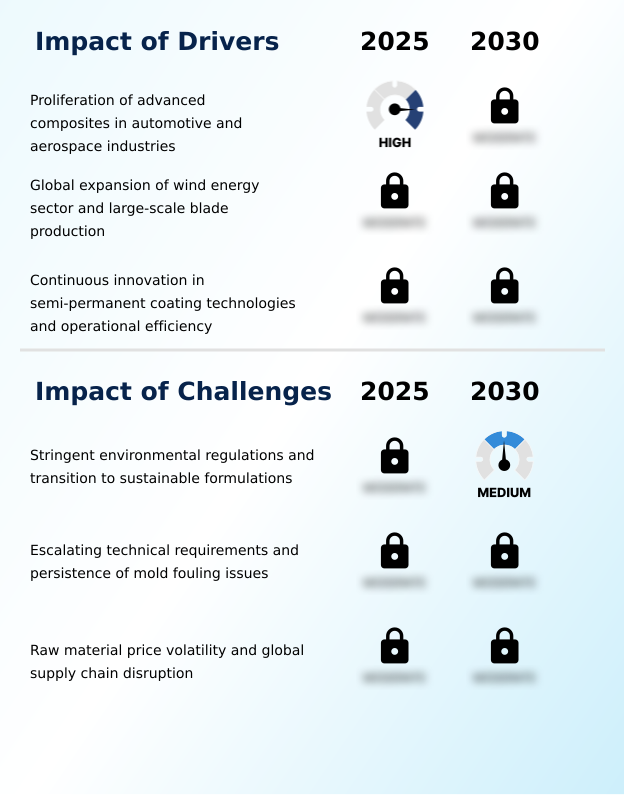
What are the key market drivers leading to the rise in the adoption of Mold Release Coatings Industry?

  • The proliferation of advanced composites within the automotive and aerospace industries serves as a primary catalyst for expanding demand.

  • The rapid expansion of high-performance elastomer manufacturing serves as a critical catalyst accelerating adoption within the Mold Release Coatings Market.
  • As tire and automotive seal production intensifies, the necessity to withstand extreme vulcanization temperatures drives the demand for specialized semi-permanent barriers. Facilities utilizing these advanced chemistries report that scrap rate reduction has improved by 20%, directly lowering raw material waste.
  • Furthermore, the processing of complex ethylene propylene diene monomer and nitrile butadiene rubber requires robust formulations to prevent tearing during extraction.
  • By eliminating the reliance on heavy silicone oils, manufacturers have enhanced secondary adhesive bonding reliability, subsequently decreasing post-cure finishing times by 15%. This measurable gain in operational throughput underscores the vital economic impact of implementing sophisticated, non-transferable release film technologies.

What are the market trends shaping the Mold Release Coatings Industry?

  • A strategic pivot toward sustainable and water-based formulations is rapidly emerging as a defining trend. This shift reflects an industry-wide commitment to environmental compliance and improved operational safety.

  • The integration of automated application technologies is fundamentally transforming operational capabilities within the Mold Release Coatings Market. Facilities deploying robotic systems for automated fiber placement have achieved a 25% improvement in coating uniformity compared to manual spraying methods. This technological shift directly addresses the need for microscopic surface porosity control during complex resin transfer molding operations.
  • As manufacturers transition to smart manufacturing, the use of targeted synthetic siloxane chemistries has lowered cycle friction, accelerating production speeds by 18%. The strategic adoption of advanced release force analytics enables operators to monitor tooling health in real time, reducing unexpected equipment failures.
  • Consequently, this data-driven approach enhances demolding cycle efficiency and supports consistent styrene accumulation prevention, ensuring pristine component quality across high-volume automotive and consumer electronics fabrication lines.

What challenges does the Mold Release Coatings Industry face during its growth?

  • Stringent environmental regulations and the complex transition to sustainable formulations pose significant technical and operational hurdles for industry participants.

  • Navigating stringent environmental mandates regarding volatile organic compound reduction remains a formidable obstacle within the Mold Release Coatings Market. The mandated phase-out of traditional solvent carriers forces manufacturers to reformulate products using aqueous carrier phases, which frequently struggle to match historical evaporation rates.
  • Facilities testing these new formulations have experienced a 12% increase in initial drying times, inadvertently slowing high-speed compression molding cycles. Additionally, maintaining thermal stability limits without relying on restricted fluorinated compounds complicates the processing of aggressive fluoroelastomers. Overcoming these chemical limitations requires substantial research investments to ensure zero chemical transfer and adequate mold fouling mitigation.
  • If these advanced aqueous systems fail to properly wet the tooling surface, processors risk increased defect rates and costly production delays.

Exclusive Technavio Analysis on Customer Landscape

The mold release coatings market forecasting report includes the adoption lifecycle of the market, covering from the innovator’s stage to the laggard’s stage. It focuses on adoption rates in different regions based on penetration. Furthermore, the mold release coatings market report also includes key purchase criteria and drivers of price sensitivity to help companies evaluate and develop their market growth analysis strategies.
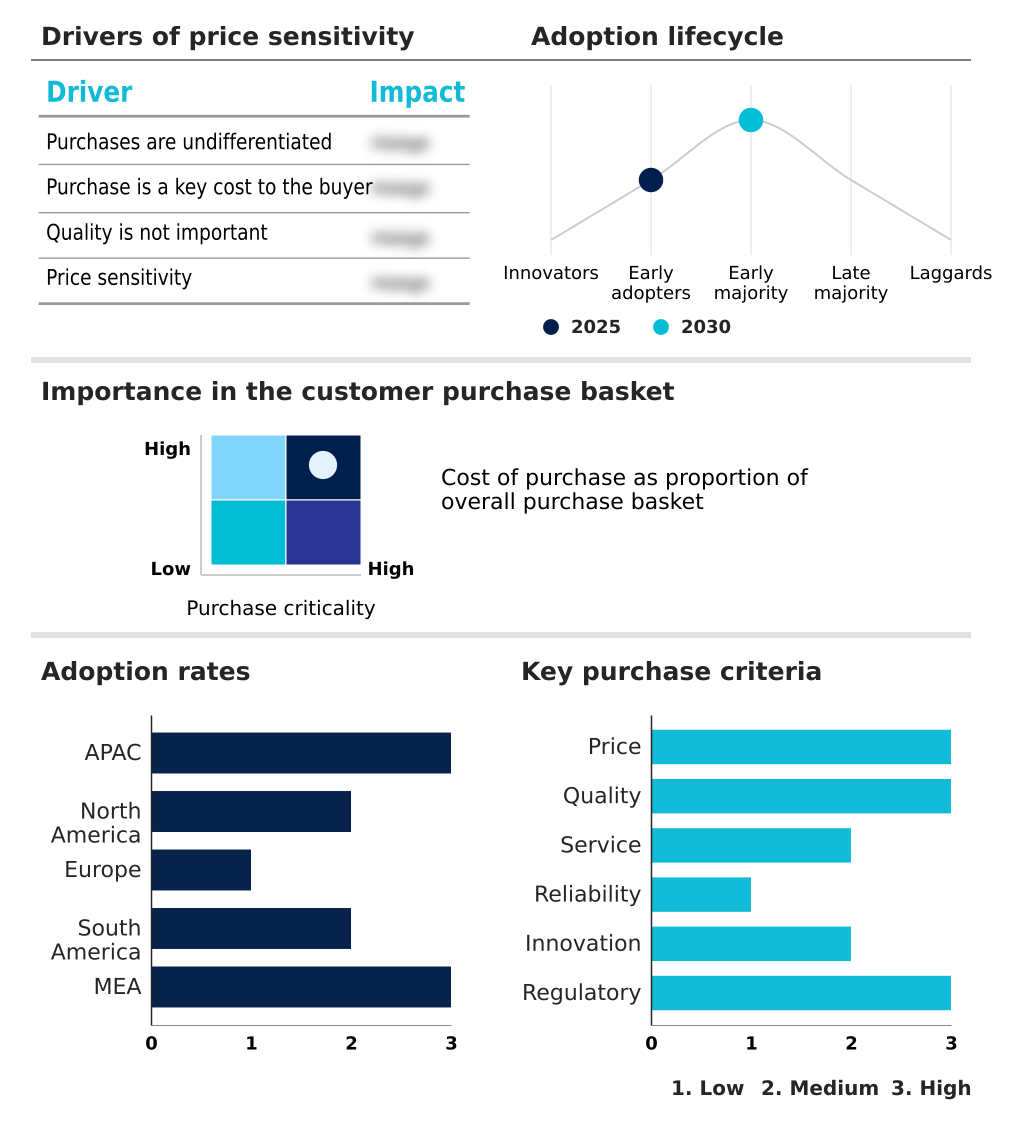
Customer Landscape of Mold Release Coatings Industry

Competitive Landscape

Companies are implementing various strategies, such as strategic alliances, mold release coatings market forecast, partnerships, mergers and acquisitions, geographical expansion, and product/service launches, to enhance their presence in the industry.

Axel Plastics Research - The portfolio features specialized internal lubricants and external mold release formulations optimized for plastics, rubber, and polyurethane processing to enhance demolding efficiency and minimize production downtime.

The industry research and growth report includes detailed analyses of the competitive landscape of the market and information about key companies, including:

  • Axel Plastics Research
  • Chem Trend LP
  • CHUKYO Europe GmbH
  • CRC Industries
  • Cresset Chemical Co.
  • Daikin Industries Ltd.
  • Dow Chemical Co.
  • Elkem ASA
  • Henkel AG and Co. KGaA
  • Lanxess AG
  • Marbocote Ltd.
  • McGee Industries Inc.
  • Michelman Inc.
  • Miller Stephenson Inc.
  • Momentive Materials Inc.
  • Nanoplas Inc.
  • Parker Hannifin Corp.
  • REXCO
  • Smooth On Inc.
  • Wacker Chemie AG

Qualitative and quantitative analysis of companies has been conducted to help clients understand the wider business environment as well as the strengths and weaknesses of key industry players. Data is qualitatively analyzed to categorize companies as pure play, category-focused, industry-focused, and diversified; it is quantitatively analyzed to categorize companies as dominant, leading, strong, tentative, and weak.

Recent Development and News in Mold release coatings market

  • In the Specialty Chemicals industry, the rapid transition toward low-emission manufacturing mandates has accelerated the phase-out of traditional solvent carriers, directly impacting Mold Release Coatings demand by driving the adoption of non-transferable release film technologies.
  • The expansion of hydrometallurgical recycling and advanced composite processing requires robust thermal stability limits, forcing a shift in Mold Release Coatings supply chains toward more resilient sacrificial release barrier formulations.
  • Stringent environmental regulations targeting perfluorinated substances have restricted conventional chemical inputs, prompting Mold Release Coatings formulators to prioritize moisture-sensitive processing alternatives that ensure pinhole defect elimination.
  • The integration of smart manufacturing synchronization across chemical production facilities has optimized material consumption rates by 20%, enhancing Mold Release Coatings applications through precise release force analytics and automated micro-dosing spray systems.

Dive into Technavio’s robust research methodology, blending expert interviews, extensive data synthesis, and validated models for unparalleled Mold Release Coatings Market insights. See full methodology.

Market Scope
Page number 320
Base year 2025
Historic period 2020-2024
Forecast period 2026-2030
Growth momentum & CAGR Accelerate at a CAGR of 5.7%
Market growth 2026-2030 USD 331.2 million
Market structure Fragmented
YoY growth 2025-2026(%) 5.5%
Key countries China, Japan, India, South Korea, Australia, Indonesia, US, Canada, Mexico, Germany, UK, France, Italy, Spain, The Netherlands, Brazil, Argentina, Chile, Turkey, Saudi Arabia, UAE, South Africa and Egypt
Competitive landscape Leading Companies, Market Positioning of Companies, Competitive Strategies, and Industry Risks

Request Free Sample

Research Analyst Overview

  • The Mold Release Coatings Market demonstrates robust structural expansion as manufacturers prioritize flawless part separation and extended tooling longevity. The transition toward biodegradable ester carriers enables industrial processors to meet stringent regulatory standards while maintaining critical thermal resilience.
  • High-speed production facilities adopting these advanced formulations have achieved a 30% reduction in processing time by eliminating the need for frequent mold degreasing. In the aerospace sector, specialized polymeric release resins are essential to withstand severe autoclave cure cycles and ensure pristine surface finishes. The integration of fluoropolymer dispersions prevents aggressive resin adherence during complex vacuum infusion molding operations.
  • Furthermore, the deployment of emulsified siloxanes supports clean demolding, optimizing downstream adhesion and painting workflows. Advanced semi-permanent polymeric nanocoatings establish a durable interface that yields multiple defect-free cycles per application. By enhancing process reliability, these precision coatings directly influence boardroom-level product strategies, allowing manufacturers to scale the production of intricate geometries while sustaining consistent quality control across demanding environments.

What are the Key Data Covered in this Mold Release Coatings Market Research and Growth Report?

  • What is the expected growth of the Mold Release Coatings Market between 2026 and 2030?

    • USD 331.2 million, at a CAGR of 5.7%

  • What segmentation does the market report cover?

    • The report is segmented by Product Type (Water-based, and Solvent-based), Type (Semi-permanent, and Sacrificial), Material Type (Rubber and elastomers, Plastics and polymers, Composites, and Others), End-user (Automotive, Building and construction, Aerospace and defense, and Others) and Geography (APAC, North America, Europe, South America, Middle East and Africa)

  • Which regions are analyzed in the report?

    • APAC, North America, Europe, South America and Middle East and Africa

  • What are the key growth drivers and market challenges?

    • Proliferation of advanced composites in automotive and aerospace industries, Stringent environmental regulations and transition to sustainable formulations

  • Who are the major players in the Mold Release Coatings Market?

    • Axel Plastics Research, Chem Trend LP, CHUKYO Europe GmbH, CRC Industries, Cresset Chemical Co., Daikin Industries Ltd., Dow Chemical Co., Elkem ASA, Henkel AG and Co. KGaA, Lanxess AG, Marbocote Ltd., McGee Industries Inc., Michelman Inc., Miller Stephenson Inc., Momentive Materials Inc., Nanoplas Inc., Parker Hannifin Corp., REXCO, Smooth On Inc. and Wacker Chemie AG

Market Research Insights

  • The Mold Release Coatings Market is evolving through the deployment of advanced surface tension reduction technologies. Facilities integrating automated micro-dosing spray systems have improved chemical transfer precision, reducing material waste by 22% compared to manual application methods. Furthermore, the adoption of semi-permanent formulations has optimized demolding cycle efficiency, leading to a 35% decrease in routine mold cleaning intervals.
  • This shift directly supports carbon footprint evaluation goals by lowering overall solvent consumption. By prioritizing surface defect minimization, manufacturers ensure high-quality post-cure finishing, ultimately yielding a 14% reduction in component rejection rates. These measurable operational enhancements solidify the critical role of innovative release chemistry in modern high-speed production environments.

We can help! Our analysts can customize this mold release coatings market research report to meet your requirements.

Get in touch

1. Executive Summary

1.1 Market overview

Executive Summary - Chart on Market Overview
Executive Summary - Data Table on Market Overview
Executive Summary - Chart on Global Market Characteristics
Executive Summary - Chart on Market by Geography
Executive Summary - Chart on Market Segmentation by Product Type
Executive Summary - Chart on Market Segmentation by Type
Executive Summary - Chart on Market Segmentation by Material Type
Executive Summary - Chart on Market Segmentation by End-user
Executive Summary - Chart on Incremental Growth
Executive Summary - Data Table on Incremental Growth
Executive Summary - Chart on Company Market Positioning

2. Technavio Analysis

2.1 Analysis of price sensitivity, lifecycle, customer purchase basket, adoption rates, and purchase criteria

2.2 Criticality of inputs and Factors of differentiation

Chart on Overview on criticality of inputs and factors of differentiation

2.3 Factors of disruption

Chart on Overview on factors of disruption

2.4 Impact of drivers and challenges

Chart on Impact of drivers and challenges in 2025 and 2030

3. Market Landscape

3.1 Market ecosystem

Chart on Parent Market
Data Table on - Parent Market

3.2 Market characteristics

Chart on Market characteristics analysis

3.3 Value chain analysis

Chart on Value chain analysis

4. Market Sizing

4.1 Market definition

Data Table on Offerings of companies included in the market definition

4.2 Market segment analysis

Market segments

4.3 Market size 2025

4.4 Market outlook: Forecast for 2025-2030

Chart on Global - Market size and forecast 2025-2030 ($ million)
Data Table on Global - Market size and forecast 2025-2030 ($ million)
Chart on Global Market: Year-over-year growth 2025-2030 (%)
Data Table on Global Market: Year-over-year growth 2025-2030 (%)

5. Historic Market Size

5.1 Global Mold Release Coatings Market 2020 - 2024

Historic Market Size - Data Table on Global Mold Release Coatings Market 2020 - 2024 ($ million)

5.2 Product Type segment analysis 2020 - 2024

Historic Market Size - Product Type Segment 2020 - 2024 ($ million)

5.3 Type segment analysis 2020 - 2024

Historic Market Size - Type Segment 2020 - 2024 ($ million)

5.4 Material Type segment analysis 2020 - 2024

Historic Market Size - Material Type Segment 2020 - 2024 ($ million)

5.5 End-user segment analysis 2020 - 2024

Historic Market Size - End-user Segment 2020 - 2024 ($ million)

5.6 Geography segment analysis 2020 - 2024

Historic Market Size - Geography Segment 2020 - 2024 ($ million)

5.7 Country segment analysis 2020 - 2024

Historic Market Size - Country Segment 2020 - 2024 ($ million)

6. Qualitative Analysis

6.1 Impact of AI on Global Mold Release Coatings market

6.2 Impact of Geopolitical Conflicts on Global Mold Release Coatings market

7. Five Forces Analysis

7.1 Five forces summary

Five forces analysis - Comparison between 2025 and 2030

7.2 Bargaining power of buyers

Bargaining power of buyers - Impact of key factors 2025 and 2030

7.3 Bargaining power of suppliers

Bargaining power of suppliers - Impact of key factors in 2025 and 2030

7.4 Threat of new entrants

Threat of new entrants - Impact of key factors in 2025 and 2030

7.5 Threat of substitutes

Threat of substitutes - Impact of key factors in 2025 and 2030

7.6 Threat of rivalry

Threat of rivalry - Impact of key factors in 2025 and 2030

7.7 Market condition

Chart on Market condition - Five forces 2025 and 2030

8. Market Segmentation by Product Type

8.1 Market segments

Chart on Product Type - Market share 2025-2030 (%)
Data Table on Product Type - Market share 2025-2030 (%)

8.2 Comparison by Product Type

Chart on Comparison by Product Type
Data Table on Comparison by Product Type

8.3 Water-based - Market size and forecast 2025-2030

Chart on Water-based - Market size and forecast 2025-2030 ($ million)
Data Table on Water-based - Market size and forecast 2025-2030 ($ million)
Chart on Water-based - Year-over-year growth 2025-2030 (%)
Data Table on Water-based - Year-over-year growth 2025-2030 (%)

8.4 Solvent-based - Market size and forecast 2025-2030

Chart on Solvent-based - Market size and forecast 2025-2030 ($ million)
Data Table on Solvent-based - Market size and forecast 2025-2030 ($ million)
Chart on Solvent-based - Year-over-year growth 2025-2030 (%)
Data Table on Solvent-based - Year-over-year growth 2025-2030 (%)

8.5 Market opportunity by Product Type

Market opportunity by Product Type ($ million)
Data Table on Market opportunity by Product Type ($ million)

9. Market Segmentation by Type

9.1 Market segments

Chart on Type - Market share 2025-2030 (%)
Data Table on Type - Market share 2025-2030 (%)

9.2 Comparison by Type

Chart on Comparison by Type
Data Table on Comparison by Type

9.3 Semi-permanent - Market size and forecast 2025-2030

Chart on Semi-permanent - Market size and forecast 2025-2030 ($ million)
Data Table on Semi-permanent - Market size and forecast 2025-2030 ($ million)
Chart on Semi-permanent - Year-over-year growth 2025-2030 (%)
Data Table on Semi-permanent - Year-over-year growth 2025-2030 (%)

9.4 Sacrificial - Market size and forecast 2025-2030

Chart on Sacrificial - Market size and forecast 2025-2030 ($ million)
Data Table on Sacrificial - Market size and forecast 2025-2030 ($ million)
Chart on Sacrificial - Year-over-year growth 2025-2030 (%)
Data Table on Sacrificial - Year-over-year growth 2025-2030 (%)

9.5 Market opportunity by Type

Market opportunity by Type ($ million)
Data Table on Market opportunity by Type ($ million)

10. Market Segmentation by Material Type

10.1 Market segments

Chart on Market Segmentation by Material Type - Market share 2025-2030 (%)
Data Table on Market Segmentation by Material Type - Market share 2025-2030 (%)

10.2 Comparison by Market Segmentation by Material Type

Chart on Comparison by Market Segmentation by Material Type
Data Table on Comparison by Market Segmentation by Material Type

10.3 Rubber and elastomers - Market size and forecast 2025-2030

Chart on Rubber and elastomers - Market size and forecast 2025-2030 ($ million)
Data Table on Rubber and elastomers - Market size and forecast 2025-2030 ($ million)
Chart on Rubber and elastomers - Year-over-year growth 2025-2030 (%)
Data Table on Rubber and elastomers - Year-over-year growth 2025-2030 (%)

10.4 Plastics and polymers - Market size and forecast 2025-2030

Chart on Plastics and polymers - Market size and forecast 2025-2030 ($ million)
Data Table on Plastics and polymers - Market size and forecast 2025-2030 ($ million)
Chart on Plastics and polymers - Year-over-year growth 2025-2030 (%)
Data Table on Plastics and polymers - Year-over-year growth 2025-2030 (%)

10.5 Composites - Market size and forecast 2025-2030

Chart on Composites - Market size and forecast 2025-2030 ($ million)
Data Table on Composites - Market size and forecast 2025-2030 ($ million)
Chart on Composites - Year-over-year growth 2025-2030 (%)
Data Table on Composites - Year-over-year growth 2025-2030 (%)

10.6 Others - Market size and forecast 2025-2030

Chart on Others - Market size and forecast 2025-2030 ($ million)
Data Table on Others - Market size and forecast 2025-2030 ($ million)
Chart on Others - Year-over-year growth 2025-2030 (%)
Data Table on Others - Year-over-year growth 2025-2030 (%)

10.7 Market opportunity by Market Segmentation by Material Type

Market opportunity by Market Segmentation by Material Type ($ million)
Data Table on Market opportunity by Market Segmentation by Material Type ($ million)

11. Market Segmentation by End-user

11.1 Market segments

Chart on End-user - Market share 2025-2030 (%)
Data Table on End-user - Market share 2025-2030 (%)

11.2 Comparison by End-user

Chart on Comparison by End-user
Data Table on Comparison by End-user

11.3 Automotive - Market size and forecast 2025-2030

Chart on Automotive - Market size and forecast 2025-2030 ($ million)
Data Table on Automotive - Market size and forecast 2025-2030 ($ million)
Chart on Automotive - Year-over-year growth 2025-2030 (%)
Data Table on Automotive - Year-over-year growth 2025-2030 (%)

11.4 Building and construction - Market size and forecast 2025-2030

Chart on Building and construction - Market size and forecast 2025-2030 ($ million)
Data Table on Building and construction - Market size and forecast 2025-2030 ($ million)
Chart on Building and construction - Year-over-year growth 2025-2030 (%)
Data Table on Building and construction - Year-over-year growth 2025-2030 (%)

11.5 Aerospace and defense - Market size and forecast 2025-2030

Chart on Aerospace and defense - Market size and forecast 2025-2030 ($ million)
Data Table on Aerospace and defense - Market size and forecast 2025-2030 ($ million)
Chart on Aerospace and defense - Year-over-year growth 2025-2030 (%)
Data Table on Aerospace and defense - Year-over-year growth 2025-2030 (%)

11.6 Others - Market size and forecast 2025-2030

Chart on Others - Market size and forecast 2025-2030 ($ million)
Data Table on Others - Market size and forecast 2025-2030 ($ million)
Chart on Others - Year-over-year growth 2025-2030 (%)
Data Table on Others - Year-over-year growth 2025-2030 (%)

11.7 Market opportunity by End-user

Market opportunity by End-user ($ million)
Data Table on Market opportunity by End-user ($ million)

12. Customer Landscape

12.1 Customer landscape overview

Analysis of price sensitivity, lifecycle, customer purchase basket, adoption rates, and purchase criteria

13. Geographic Landscape

13.1 Geographic segmentation

Chart on Market share by geography 2025-2030 (%)
Data Table on Market share by geography 2025-2030 (%)

13.2 Geographic comparison

Chart on Geographic comparison
Data Table on Geographic comparison

13.3 APAC - Market size and forecast 2025-2030

Chart on APAC - Market size and forecast 2025-2030 ($ million)
Data Table on APAC - Market size and forecast 2025-2030 ($ million)
Chart on APAC - Year-over-year growth 2025-2030 (%)
Data Table on APAC - Year-over-year growth 2025-2030 (%)
Chart on Regional Comparison - APAC
Data Table on Regional Comparison - APAC

13.3.1 China - Market size and forecast 2025-2030

Chart on China - Market size and forecast 2025-2030 ($ million)
Data Table on China - Market size and forecast 2025-2030 ($ million)
Chart on China - Year-over-year growth 2025-2030 (%)
Data Table on China - Year-over-year growth 2025-2030 (%)

13.3.2 Japan - Market size and forecast 2025-2030

Chart on Japan - Market size and forecast 2025-2030 ($ million)
Data Table on Japan - Market size and forecast 2025-2030 ($ million)
Chart on Japan - Year-over-year growth 2025-2030 (%)
Data Table on Japan - Year-over-year growth 2025-2030 (%)

13.3.3 India - Market size and forecast 2025-2030

Chart on India - Market size and forecast 2025-2030 ($ million)
Data Table on India - Market size and forecast 2025-2030 ($ million)
Chart on India - Year-over-year growth 2025-2030 (%)
Data Table on India - Year-over-year growth 2025-2030 (%)

13.3.4 South Korea - Market size and forecast 2025-2030

Chart on South Korea - Market size and forecast 2025-2030 ($ million)
Data Table on South Korea - Market size and forecast 2025-2030 ($ million)
Chart on South Korea - Year-over-year growth 2025-2030 (%)
Data Table on South Korea - Year-over-year growth 2025-2030 (%)

13.3.5 Australia - Market size and forecast 2025-2030

Chart on Australia - Market size and forecast 2025-2030 ($ million)
Data Table on Australia - Market size and forecast 2025-2030 ($ million)
Chart on Australia - Year-over-year growth 2025-2030 (%)
Data Table on Australia - Year-over-year growth 2025-2030 (%)

13.3.6 Indonesia - Market size and forecast 2025-2030

Chart on Indonesia - Market size and forecast 2025-2030 ($ million)
Data Table on Indonesia - Market size and forecast 2025-2030 ($ million)
Chart on Indonesia - Year-over-year growth 2025-2030 (%)
Data Table on Indonesia - Year-over-year growth 2025-2030 (%)

13.4 North America - Market size and forecast 2025-2030

Chart on North America - Market size and forecast 2025-2030 ($ million)
Data Table on North America - Market size and forecast 2025-2030 ($ million)
Chart on North America - Year-over-year growth 2025-2030 (%)
Data Table on North America - Year-over-year growth 2025-2030 (%)
Chart on Regional Comparison - North America
Data Table on Regional Comparison - North America

13.4.1 US - Market size and forecast 2025-2030

Chart on US - Market size and forecast 2025-2030 ($ million)
Data Table on US - Market size and forecast 2025-2030 ($ million)
Chart on US - Year-over-year growth 2025-2030 (%)
Data Table on US - Year-over-year growth 2025-2030 (%)

13.4.2 Canada - Market size and forecast 2025-2030

Chart on Canada - Market size and forecast 2025-2030 ($ million)
Data Table on Canada - Market size and forecast 2025-2030 ($ million)
Chart on Canada - Year-over-year growth 2025-2030 (%)
Data Table on Canada - Year-over-year growth 2025-2030 (%)

13.4.3 Mexico - Market size and forecast 2025-2030

Chart on Mexico - Market size and forecast 2025-2030 ($ million)
Data Table on Mexico - Market size and forecast 2025-2030 ($ million)
Chart on Mexico - Year-over-year growth 2025-2030 (%)
Data Table on Mexico - Year-over-year growth 2025-2030 (%)

13.5 Europe - Market size and forecast 2025-2030

Chart on Europe - Market size and forecast 2025-2030 ($ million)
Data Table on Europe - Market size and forecast 2025-2030 ($ million)
Chart on Europe - Year-over-year growth 2025-2030 (%)
Data Table on Europe - Year-over-year growth 2025-2030 (%)
Chart on Regional Comparison - Europe
Data Table on Regional Comparison - Europe

13.5.1 Germany - Market size and forecast 2025-2030

Chart on Germany - Market size and forecast 2025-2030 ($ million)
Data Table on Germany - Market size and forecast 2025-2030 ($ million)
Chart on Germany - Year-over-year growth 2025-2030 (%)
Data Table on Germany - Year-over-year growth 2025-2030 (%)

13.5.2 UK - Market size and forecast 2025-2030

Chart on UK - Market size and forecast 2025-2030 ($ million)
Data Table on UK - Market size and forecast 2025-2030 ($ million)
Chart on UK - Year-over-year growth 2025-2030 (%)
Data Table on UK - Year-over-year growth 2025-2030 (%)

13.5.3 France - Market size and forecast 2025-2030

Chart on France - Market size and forecast 2025-2030 ($ million)
Data Table on France - Market size and forecast 2025-2030 ($ million)
Chart on France - Year-over-year growth 2025-2030 (%)
Data Table on France - Year-over-year growth 2025-2030 (%)

13.5.4 Italy - Market size and forecast 2025-2030

Chart on Italy - Market size and forecast 2025-2030 ($ million)
Data Table on Italy - Market size and forecast 2025-2030 ($ million)
Chart on Italy - Year-over-year growth 2025-2030 (%)
Data Table on Italy - Year-over-year growth 2025-2030 (%)

13.5.5 Spain - Market size and forecast 2025-2030

Chart on Spain - Market size and forecast 2025-2030 ($ million)
Data Table on Spain - Market size and forecast 2025-2030 ($ million)
Chart on Spain - Year-over-year growth 2025-2030 (%)
Data Table on Spain - Year-over-year growth 2025-2030 (%)

13.5.6 The Netherlands - Market size and forecast 2025-2030

Chart on The Netherlands - Market size and forecast 2025-2030 ($ million)
Data Table on The Netherlands - Market size and forecast 2025-2030 ($ million)
Chart on The Netherlands - Year-over-year growth 2025-2030 (%)
Data Table on The Netherlands - Year-over-year growth 2025-2030 (%)

13.6 South America - Market size and forecast 2025-2030

Chart on South America - Market size and forecast 2025-2030 ($ million)
Data Table on South America - Market size and forecast 2025-2030 ($ million)
Chart on South America - Year-over-year growth 2025-2030 (%)
Data Table on South America - Year-over-year growth 2025-2030 (%)
Chart on Regional Comparison - South America
Data Table on Regional Comparison - South America

13.6.1 Brazil - Market size and forecast 2025-2030

Chart on Brazil - Market size and forecast 2025-2030 ($ million)
Data Table on Brazil - Market size and forecast 2025-2030 ($ million)
Chart on Brazil - Year-over-year growth 2025-2030 (%)
Data Table on Brazil - Year-over-year growth 2025-2030 (%)

13.6.2 Argentina - Market size and forecast 2025-2030

Chart on Argentina - Market size and forecast 2025-2030 ($ million)
Data Table on Argentina - Market size and forecast 2025-2030 ($ million)
Chart on Argentina - Year-over-year growth 2025-2030 (%)
Data Table on Argentina - Year-over-year growth 2025-2030 (%)

13.6.3 Chile - Market size and forecast 2025-2030

Chart on Chile - Market size and forecast 2025-2030 ($ million)
Data Table on Chile - Market size and forecast 2025-2030 ($ million)
Chart on Chile - Year-over-year growth 2025-2030 (%)
Data Table on Chile - Year-over-year growth 2025-2030 (%)

13.7 Middle East and Africa - Market size and forecast 2025-2030

Chart on Middle East and Africa - Market size and forecast 2025-2030 ($ million)
Data Table on Middle East and Africa - Market size and forecast 2025-2030 ($ million)
Chart on Middle East and Africa - Year-over-year growth 2025-2030 (%)
Data Table on Middle East and Africa - Year-over-year growth 2025-2030 (%)
Chart on Regional Comparison - Middle East and Africa
Data Table on Regional Comparison - Middle East and Africa

13.7.1 Turkey - Market size and forecast 2025-2030

Chart on Turkey - Market size and forecast 2025-2030 ($ million)
Data Table on Turkey - Market size and forecast 2025-2030 ($ million)
Chart on Turkey - Year-over-year growth 2025-2030 (%)
Data Table on Turkey - Year-over-year growth 2025-2030 (%)

13.7.2 Saudi Arabia - Market size and forecast 2025-2030

Chart on Saudi Arabia - Market size and forecast 2025-2030 ($ million)
Data Table on Saudi Arabia - Market size and forecast 2025-2030 ($ million)
Chart on Saudi Arabia - Year-over-year growth 2025-2030 (%)
Data Table on Saudi Arabia - Year-over-year growth 2025-2030 (%)

13.7.3 UAE - Market size and forecast 2025-2030

Chart on UAE - Market size and forecast 2025-2030 ($ million)
Data Table on UAE - Market size and forecast 2025-2030 ($ million)
Chart on UAE - Year-over-year growth 2025-2030 (%)
Data Table on UAE - Year-over-year growth 2025-2030 (%)

13.7.4 South Africa - Market size and forecast 2025-2030

Chart on South Africa - Market size and forecast 2025-2030 ($ million)
Data Table on South Africa - Market size and forecast 2025-2030 ($ million)
Chart on South Africa - Year-over-year growth 2025-2030 (%)
Data Table on South Africa - Year-over-year growth 2025-2030 (%)

13.7.5 Egypt - Market size and forecast 2025-2030

Chart on Egypt - Market size and forecast 2025-2030 ($ million)
Data Table on Egypt - Market size and forecast 2025-2030 ($ million)
Chart on Egypt - Year-over-year growth 2025-2030 (%)
Data Table on Egypt - Year-over-year growth 2025-2030 (%)

13.8 Market opportunity by geography

Market opportunity by geography ($ million)
Data Tables on Market opportunity by geography ($ million)

14. Drivers, Challenges, and Opportunity

14.1 Market drivers

Proliferation of advanced composites in automotive and aerospace industries
Global expansion of wind energy sector and large-scale blade production
Continuous innovation in semi-permanent coating technologies and operational efficiency

14.2 Market challenges

Stringent environmental regulations and transition to sustainable formulations
Escalating technical requirements and persistence of mold fouling issues
Raw material price volatility and global supply chain disruption

14.3 Impact of drivers and challenges

Impact of drivers and challenges in 2025 and 2030

14.4 Market opportunities

Strategic pivot toward sustainable and water based formulations
Integration of industry 4.0 and precision automated application systems
Advancements in nanotechnology and molecular level surface engineering

15. Competitive Landscape

15.1 Overview

15.2

Overview on criticality of inputs and factors of differentiation

15.3 Landscape disruption

Overview on factors of disruption

15.4 Industry risks

Impact of key risks on business

16. Competitive Analysis

16.1 Companies profiled

Companies covered

16.2 Company ranking index

16.3 Market positioning of companies

Matrix on companies position and classification

16.4 Chem Trend LP

Chem Trend LP - Overview
Chem Trend LP - Product / Service
Chem Trend LP - Key offerings
SWOT

16.5 CHUKYO Europe GmbH

CHUKYO Europe GmbH - Overview
CHUKYO Europe GmbH - Product / Service
CHUKYO Europe GmbH - Key offerings
SWOT

16.6 CRC Industries

CRC Industries - Overview
CRC Industries - Product / Service
CRC Industries - Key offerings
SWOT

16.7 Daikin Industries Ltd.

Daikin Industries Ltd. - Overview
Daikin Industries Ltd. - Product / Service
Daikin Industries Ltd. - Key offerings
SWOT

16.8 Dow Chemical Co.

Dow Chemical Co. - Overview
Dow Chemical Co. - Business segments
Dow Chemical Co. - Key news
Dow Chemical Co. - Key offerings
Dow Chemical Co. - Segment focus
SWOT

16.9 Elkem ASA

Elkem ASA - Overview
Elkem ASA - Business segments
Elkem ASA - Key offerings
Elkem ASA - Segment focus
SWOT

16.10 Henkel AG and Co. KGaA

Henkel AG and Co. KGaA - Overview
Henkel AG and Co. KGaA - Business segments
Henkel AG and Co. KGaA - Key offerings
Henkel AG and Co. KGaA - Segment focus
SWOT

16.11 Lanxess AG

Lanxess AG - Overview
Lanxess AG - Business segments
Lanxess AG - Key offerings
Lanxess AG - Segment focus
SWOT

16.12 McGee Industries Inc.

McGee Industries Inc. - Overview
McGee Industries Inc. - Product / Service
McGee Industries Inc. - Key offerings
SWOT

16.13 Michelman Inc.

Michelman Inc. - Overview
Michelman Inc. - Product / Service
Michelman Inc. - Key offerings
SWOT

16.14 Momentive Materials Inc.

Momentive Materials Inc. - Overview
Momentive Materials Inc. - Product / Service
Momentive Materials Inc. - Key offerings
SWOT

16.15 Parker Hannifin Corp.

Parker Hannifin Corp. - Overview
Parker Hannifin Corp. - Business segments
Parker Hannifin Corp. - Key news
Parker Hannifin Corp. - Key offerings
Parker Hannifin Corp. - Segment focus
SWOT

16.16 REXCO

REXCO - Overview
REXCO - Product / Service
REXCO - Key offerings
SWOT

16.17 Smooth On Inc.

Smooth On Inc. - Overview
Smooth On Inc. - Product / Service
Smooth On Inc. - Key offerings
SWOT

16.18 Wacker Chemie AG

Wacker Chemie AG - Overview
Wacker Chemie AG - Business segments
Wacker Chemie AG - Key offerings
Wacker Chemie AG - Segment focus
SWOT

17. Appendix

17.1 Scope of the report

Market definition
Objectives
Notes and caveats

17.2 Inclusions and exclusions checklist

Inclusions checklist
Exclusions checklist

17.3 Currency conversion rates for US$

17.4 Research methodology

17.5 Data procurement

Information sources

17.6 Data validation

17.7 Validation techniques employed for market sizing

17.8 Data synthesis

17.9 360 degree market analysis

17.10 List of abbreviations

Research Methodology

Technavio presents a detailed picture of the market by way of study, synthesis, and summation of data from multiple sources. The analysts have presented the various facets of the market with a particular focus on identifying the key industry influencers. The data thus presented is comprehensive, reliable, and the result of extensive research, both primary and secondary.

INFORMATION SOURCES

Primary sources

  • Manufacturers and suppliers
  • Channel partners
  • Industry experts
  • Strategic decision makers

Secondary sources

  • Industry journals and periodicals
  • Government data
  • Financial reports of key industry players
  • Historical data
  • Press releases

DATA ANALYSIS

Data Synthesis

  • Collation of data
  • Estimation of key figures
  • Analysis of derived insights

Data Validation

  • Triangulation with data models
  • Reference against proprietary databases
  • Corroboration with industry experts

REPORT WRITING

Qualitative

  • Market drivers
  • Market challenges
  • Market trends
  • Five forces analysis

Quantitative

  • Market size and forecast
  • Market segmentation
  • Geographical insights
  • Competitive landscape

Interested in this report?

Get your sample now to see our research methodology and insights!

Download Now

Frequently Asked Questions

Mold Release Coatings market growth will increase by USD 331.2 million during 2026-2030.

The Mold Release Coatings market is expected to grow at a CAGR of 5.7% during 2026-2030.

Mold Release Coatings market is segmented by Product type (Water-based, Solvent-based) Type (Semi-permanent, Sacrificial) Material type (Rubber and elastomers, Plastics and polymers, Composites, Others) End-user (Automotive, Building and construction, Aerospace and defense, Others)

Axel Plastics Research, Chem Trend LP, CHUKYO Europe GmbH, CRC Industries, Cresset Chemical Co., Daikin Industries Ltd., Dow Chemical Co., Elkem ASA, Henkel AG and Co. KGaA, Lanxess AG, Marbocote Ltd., McGee Industries Inc., Michelman Inc., Miller Stephenson Inc., Momentive Materials Inc., Nanoplas Inc., Parker Hannifin Corp., REXCO, Smooth On Inc., Wacker Chemie AG are a few of the key vendors in the Mold Release Coatings market.

APAC will register the highest growth rate of 46.9% among the other regions. Therefore, the Mold Release Coatings market in APAC is expected to garner significant business opportunities for the vendors during the forecast period.

China, Japan, India, South Korea, Australia, Indonesia, US, Canada, Mexico, Germany, UK, France, Italy, Spain, The Netherlands, Brazil, Argentina, Chile, Turkey, Saudi Arabia, UAE, South Africa, Egypt

  • Proliferation of advanced composites in automotive and aerospace industries is the driving factor this market.

The Mold Release Coatings market vendors should focus on grabbing business opportunities from the Product type segment as it accounted for the largest market share in the base year.
RIA - Research AI Assistant
Ask RIA