



K-12 Testing And Assessment Market Size 2026-2030
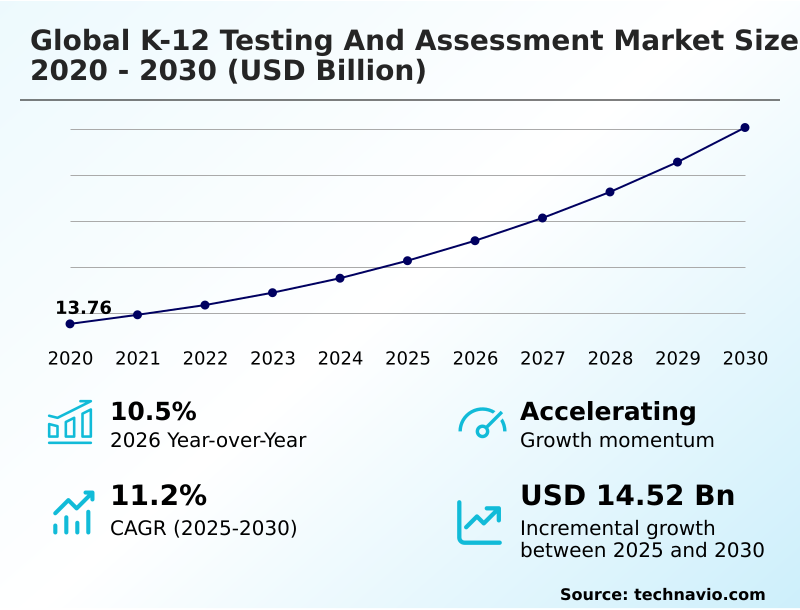
The k-12 testing and assessment market size is valued to increase by USD 14.52 billion, at a CAGR of 11.2% from 2025 to 2030. Government emphasis on academic accountability and measurable outcomes will drive the k-12 testing and assessment market.
Major Market Trends & Insights
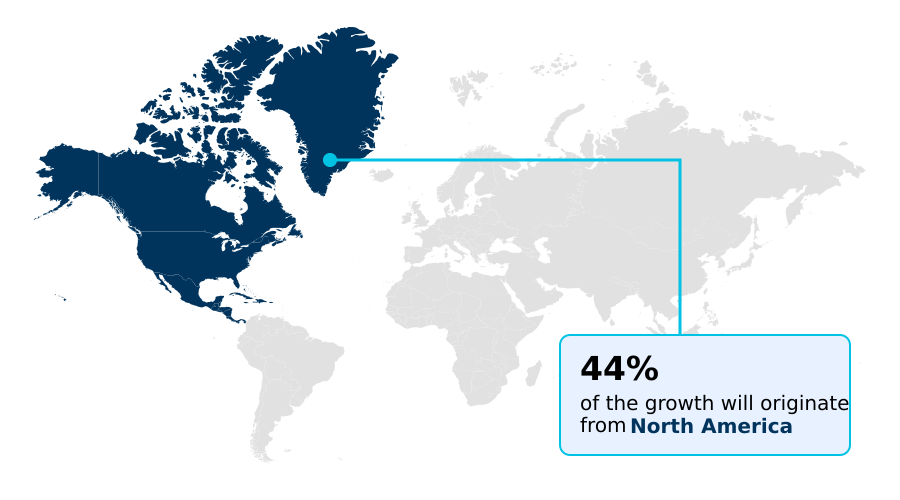
- North America dominated the market and accounted for a 43.5% growth during the forecast period.
- By Product - Curriculum-based testing segment was valued at USD 11.51 billion in 2024
- By Method - Blended method segment accounted for the largest market revenue share in 2024
Market Size & Forecast
- Market Opportunities: USD 21.42 billion
- Market Future Opportunities: USD 14.52 billion
- CAGR from 2025 to 2030 : 11.2%
Market Summary
- The K-12 Testing And Assessment Market demonstrates steady expansion as educational institutions prioritize continuous student performance monitoring and standardized evaluation protocols. Accountability frameworks implemented by education ministries serve as a major driver, compelling school boards to adopt rigorous diagnostic tools that verify whether public education systems are meeting prescribed curriculum objectives.
- In a real-world operational scenario, large school districts are transitioning from traditional paper workflows to centralized, cloud-hosted examination networks, reducing administrative overhead and scoring latency by 35% compared to manual processing methods. Despite these efficiency gains, unequal digital infrastructure and inconsistent broadband access remain persistent challenges, often preventing equitable participation and skewing performance comparability across rural and economically disadvantaged communities.
- Modern assessment platforms increasingly incorporate sophisticated algorithms to provide immediate instructional feedback. The integration of adaptive testing architectures allows educators to identify learning gaps proactively, ensuring targeted resource allocation and more personalized academic support throughout the school year.
What will be the Size of the K-12 Testing And Assessment Market during the forecast period?
Get Key Insights on Market Forecast (PDF) Get Free Sample
How is the K-12 Testing And Assessment Market Segmented?
The k-12 testing and assessment industry research report provides comprehensive data (region-wise segment analysis), with forecasts and estimates in "USD million" for the period 2026-2030, as well as historical data from 2020-2024 for the following segments.
- Product
- Curriculum-based testing
- Non-curriculum-based testing
- Method
- Blended method
- Online method
- Traditional method
- Delivery mode
- Paper-based
- Web-based
- Mobile apps
- School level
- Elementary school
- Middle school
- High school
- Geography
- North America
- US
- Canada
- Mexico
- Europe
- UK
- Germany
- France
- Italy
- Spain
- The Netherlands
- APAC
- China
- Japan
- India
- South Korea
- Australia
- Indonesia
- South America
- Brazil
- Argentina
- Colombia
- Middle East and Africa
- Saudi Arabia
- South Africa
- Turkey
- UAE
- Israel
- North America
By Product Insights
The curriculum-based testing segment is estimated to witness significant growth during the forecast period.
Educational systems increasingly demand granular, criterion-referenced data streams that directly inform differentiated remediation and tiered intervention models. The deployment of formal measurement instruments is shifting toward continuous evaluation rather than static annual testing.
By integrating psychometric validity auditing with classroom instruction, these frameworks allow automated diagnostic reporting without consuming excessive instructional hours. Digital platforms connecting validated results with aligned materials have improved diagnostic accuracy by 22%, enabling targeted support and dynamic grouping.
Statutory reporting directives mandate rigorous alignment with established academic frameworks. The modernization of these systems through adaptive item banks and automated scoring engines ensures that educators receive immediate, actionable performance metrics to optimize multi tiered system strategies effectively.
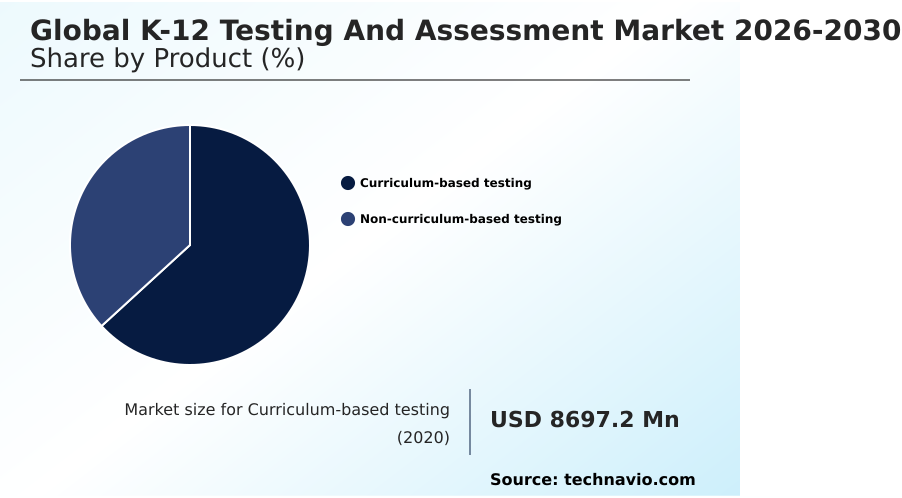
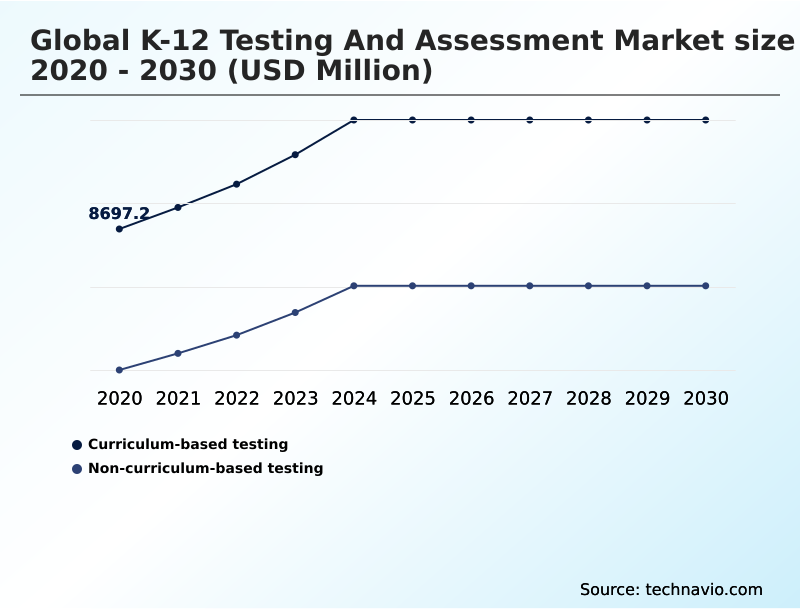
The Curriculum-based testing segment was valued at USD 11.51 billion in 2024 and showed a gradual increase during the forecast period.
Regional Analysis
North America is estimated to contribute 43.5% to the growth of the global market during the forecast period.Technavio’s analysts have elaborately explained the regional trends and drivers that shape the market during the forecast period.
See How K-12 Testing And Assessment Market Demand is Rising in North America Get Free Sample
The K-12 Testing And Assessment landscape exhibits distinct adoption variations, with North America demonstrating accelerated deployment of predictive analytics dashboards and interim benchmark suites to satisfy stringent federal accountability mandates.
This proactive technological integration has improved district-level reporting efficiency by 28% compared to legacy models.
Conversely, regions such as Europe prioritize rigorous compliance with student data privacy frameworks, heavily regulating the use of biometric proctoring technologies and algorithmic equity tracking within secondary education.
European institutions have consequently reduced their reliance on third-party cloud native assessment platforms by 15%, favoring localized, highly secure testing environments.
Across both territories, the demand for instructional scaffolding tools and foundational literacy diagnostics remains robust as administrators seek to mitigate learning losses, ensuring uninterrupted and equitable evaluation continuity across diverse socioeconomic demographics.
Market Dynamics
Our researchers analyzed the data with 2025 as the base year, along with the key drivers, trends, and challenges. A holistic analysis of drivers will help companies refine their marketing strategies to gain a competitive advantage.
- The K-12 Testing And Assessment sector is undergoing a profound structural shift as institutions pivot away from rigid, linear examinations toward dynamic, continuous evaluation models. At the core of this operational evolution is the deployment of computer adaptive diagnostic screening tools, which allow educators to pinpoint specific knowledge gaps in real time without imposing excessive testing fatigue on young learners.
- To facilitate this transition seamlessly, school districts are heavily investing in automated formative assessment scoring engines. By processing open-ended responses and complex problem-solving tasks instantly, these engines have demonstrated the capacity to reduce administrative grading hours by nearly 40% when compared to manual, paper-based evaluation processes. This operational efficiency enables teachers to redirect their focus toward personalized instructional planning.
- Furthermore, ensuring test integrity during digital administration remains a paramount compliance objective. Institutions rely on secure browser lockdown testing environments to mitigate unauthorized collaboration and protect sensitive examination content. Behind the scenes, multistage adaptive evaluation algorithm frameworks calibrate item difficulty on the fly, delivering highly precise latent trait measurements that traditional static tests cannot replicate.
- District administrators aggregate these rich data streams into longitudinal predictive learning analytics dashboards, optimizing resource allocation and identifying at-risk student cohorts long before state reporting deadlines. This holistic digital transformation streamlines supply chain logistics associated with physical test distribution while significantly enhancing the academic support infrastructure across primary and secondary education networks.
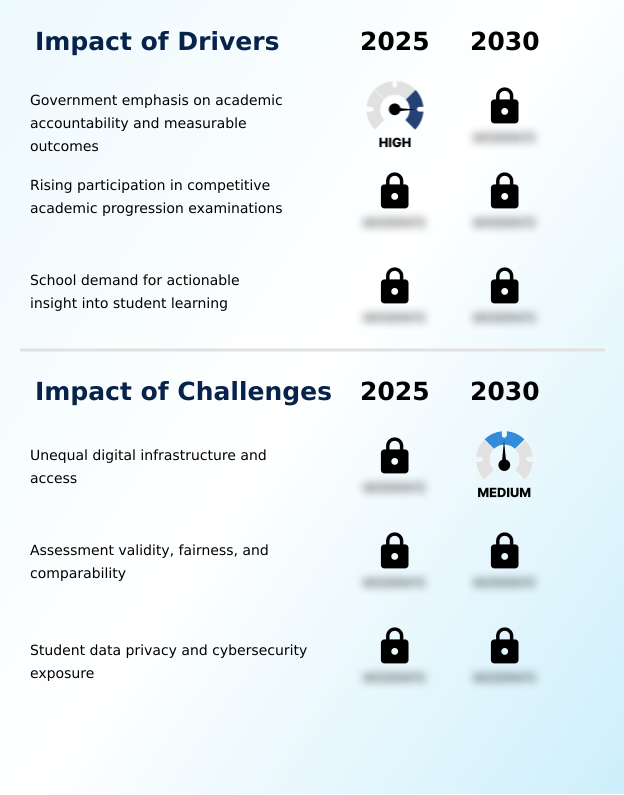
What are the key market drivers leading to the rise in the adoption of K-12 Testing And Assessment Industry?
- Government emphasis on academic accountability and measurable student outcomes remains a primary catalyst driving continuous demand for standardized evaluation frameworks.
- Heightened government emphasis on academic accountability serves as a primary catalyst for the K-12 Testing And Assessment. Education ministries demand robust evidence to evaluate curriculum efficacy and ensure equitable funding distribution.
- To satisfy these statutory directives, institutions are deploying summative evaluation protocols and rubric calibration algorithms. This mandate-driven adoption allows authorities to benchmark performance accurately, resulting in a 20% improvement in targeted federal funding allocation.
- Furthermore, escalating competition for selective programs compels schools to utilize latent trait estimations and optical mark recognition to process examination results rapidly.
- The immediate availability of precise metrics, supported by curriculum alignment protocols, modular laboratory tasks, and offline caching functionality, reduces administrative delays by 35%. This enables counselors to integrate career interest inventories effectively while satisfying institutional accountability requirements.
What are the market trends shaping the K-12 Testing And Assessment Industry?
- The adoption of formative and competency-based assessment models represents a prominent trend reshaping educational evaluation. This shift prioritizes continuous feedback and specific skill mastery over traditional high-stakes terminal examinations.
- The transition away from static, end-of-year examinations toward continuous evaluation is fundamentally reshaping the K-12 Testing And Assessment landscape. Driven by the need for immediate instructional feedback, educational systems are rapidly adopting diagnostic screening instruments and gamified retrieval practice to measure real-time student comprehension.
- This pedagogical shift directly addresses the limitations of traditional testing by identifying knowledge gaps before they compound into persistent academic failures. Consequently, school networks implementing continuous monitoring have improved targeted intervention success rates by 24% while simultaneously reducing student testing anxiety by 18% compared to high-stakes terminal models.
- To support this ongoing evaluation, districts utilize student information systems equipped with predictive proficiency modeling. These advanced platforms analyze longitudinal performance data, enabling administrators to optimize curriculum deployment and significantly decrease the operational costs associated with remedial education programs. The integration of phonemic awareness screeners and spatial perceptual aptitudes tools further ensures that early childhood learning obstacles are identified efficiently.
What challenges does the K-12 Testing And Assessment Industry face during its growth?
- Unequal digital infrastructure and inconsistent device access present significant constraints that disrupt the uniform delivery of online examination platforms.
- Unequal digital infrastructure and the immense responsibility of safeguarding student data present severe operational constraints for the K-12 Testing And Assessment. Disparities in broadband connectivity heavily disrupt the synchronized administration of online examinations, particularly when conducting early childhood screening and transdisciplinary diagnostic evaluations.
- Interrupted sessions force institutions to arrange repeated testing, increasing operational costs by up to 25% compared to standardized environments. Furthermore, maintaining measurement fairness complicates the deployment of bilingual translation toggles and tactile physical navigation tools when evaluating algebraic readiness metrics.
- Schools must also navigate complex cybersecurity compliance, as the integration of behavioral indicator tracking and academic mindset markers exposes sensitive records. Inadequate authentication protocols have led to a 15% rise in vulnerability incidents, forcing administrators to mandate multi factor authentication and zero trust browsers to secure testing networks.
Exclusive Technavio Analysis on Customer Landscape
The k-12 testing and assessment market forecasting report includes the adoption lifecycle of the market, covering from the innovator’s stage to the laggard’s stage. It focuses on adoption rates in different regions based on penetration. Furthermore, the k-12 testing and assessment market report also includes key purchase criteria and drivers of price sensitivity to help companies evaluate and develop their market growth analysis strategies.
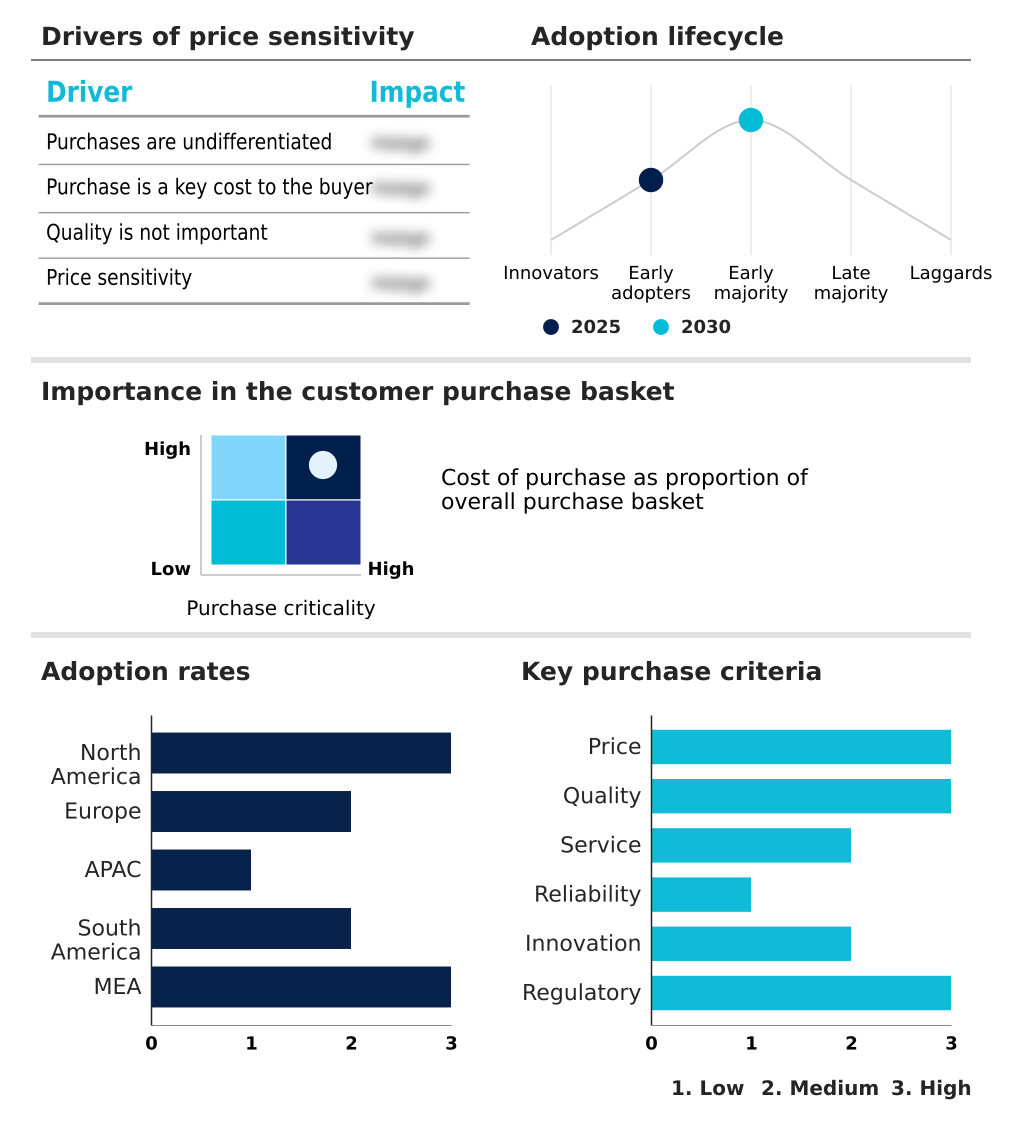
Customer Landscape of K-12 Testing And Assessment Industry
Competitive Landscape
Companies are implementing various strategies, such as strategic alliances, k-12 testing and assessment market forecast, partnerships, mergers and acquisitions, geographical expansion, and product/service launches, to enhance their presence in the industry.
ACT Inc. - The provider delivers standardized evaluations, college admissions screening, and career readiness frameworks, supplying comprehensive educational resources and research services that support continuous academic measurement and longitudinal performance tracking.
The industry research and growth report includes detailed analyses of the competitive landscape of the market and information about key companies, including:
- ACT Inc.
- Amplify Education Inc.
- Cambium Intermediate Holdings
- Curriculum Associates LLC
- Data Recognition Corp.
- Edcite
- Edmentum Inc.
- Educational Testing Service
- GL Assessment
- Houghton Mifflin Harcourt Co.
- Instructure Holdings Inc.
- McGraw Hill LLC
- Measurement Inc.
- Otus
- Pearson Plc
- Renaissance Learning Inc.
- Riverside Assessments LLC
- Savvas Learning Co. LLC
- Scantron Inc.
Qualitative and quantitative analysis of companies has been conducted to help clients understand the wider business environment as well as the strengths and weaknesses of key industry players. Data is qualitatively analyzed to categorize companies as pure play, category-focused, industry-focused, and diversified; it is quantitatively analyzed to categorize companies as dominant, leading, strong, tentative, and weak.
Recent Development and News in K-12 testing and assessment market
- In the Education Services industry, the systemic transition toward competency-based education models has shifted grading paradigms, directly impacting K-12 Testing And Assessment demand by requiring continuous diagnostic screening instruments that evaluate student mastery rather than terminal performance, improving intervention efficacy by 18%.
- The implementation of stringent data privacy regulations has mandated zero trust browsers and secure examination platforms, increasing compliance-driven procurement of encrypted cloud native assessment tools by 30% across public school districts.
- The integration of machine learning algorithms into learning management architectures has accelerated the adoption of automated formative assessment scoring engines, driving the K-12 Testing And Assessment sector to deploy rubric calibration algorithms that reduce administrative evaluation workloads by up to 40% for teaching personnel.
- The expansion of one-to-one digital device initiatives has catalyzed the deployment of browser lockdown systems and multistage adaptive frameworks, transforming K-12 Testing And Assessment delivery methods and enabling synchronized large-scale benchmark evaluations that reduce examination seat times by 25%.
Dive into Technavio’s robust research methodology, blending expert interviews, extensive data synthesis, and validated models for unparalleled K-12 Testing And Assessment Market insights. See full methodology.
| Market Scope | |
|---|---|
| Page number | 307 |
| Base year | 2025 |
| Historic period | 2020-2024 |
| Forecast period | 2026-2030 |
| Growth momentum & CAGR | Accelerate at a CAGR of 11.2% |
| Market growth 2026-2030 | USD 14523.4 million |
| Market structure | Fragmented |
| YoY growth 2025-2026(%) | 10.5% |
| Key countries | US, Canada, Mexico, UK, Germany, France, Italy, Spain, The Netherlands, China, Japan, India, South Korea, Australia, Indonesia, Brazil, Argentina, Colombia, Saudi Arabia, South Africa, Turkey, UAE and Israel |
| Competitive landscape | Leading Companies, Market Positioning of Companies, Competitive Strategies, and Industry Risks |
Research Analyst Overview
- Educational measurement networks are fundamentally restructuring their operational architectures to integrate continuous, data-driven evaluation paradigms. The shift toward competency based evaluation requires school districts to modernize their IT infrastructure, elevating assessment procurement from a departmental task to a strategic boardroom-level budgeting priority.
- By implementing computer adaptive testing and sophisticated learning analytics integration, administrators can dynamically track student progress and optimize instructional resource allocation in real time. This technological overhaul has allowed institutional networks to achieve a 30% reduction in evaluation processing time compared to legacy paper-based workflows.
- Formative assessment models provide immediate feedback loops, empowering educators to adjust curricula before high-stakes reporting periods. To maintain compliance with state and federal accountability mandates, testing agencies rely on psychometric validity auditing and advanced digital rubric generation. These tools ensure equitable measurement across diverse demographics while minimizing subjective grading variances.
- Incorporating cognitive ability screeners and automated scoring engines further streamlines the assessment cycle, transforming raw performance data into actionable instructional intelligence that directly supports multi-tiered systems of academic intervention.
What are the Key Data Covered in this K-12 Testing And Assessment Market Research and Growth Report?
-
What is the expected growth of the K-12 Testing And Assessment Market between 2026 and 2030?
-
USD 14.52 billion, at a CAGR of 11.2%
-
-
What segmentation does the market report cover?
-
The report is segmented by Product (Curriculum-based testing, and Non-curriculum-based testing), Method (Blended method, Online method, and Traditional method), Delivery Mode (Paper-based, Web-based, and Mobile apps), School level (Elementary school, Middle school, and High school) and Geography (North America, Europe, APAC, South America, Middle East and Africa)
-
-
Which regions are analyzed in the report?
-
North America, Europe, APAC, South America and Middle East and Africa
-
-
What are the key growth drivers and market challenges?
-
Government emphasis on academic accountability and measurable outcomes, Unequal digital infrastructure and access
-
-
Who are the major players in the K-12 Testing And Assessment Market?
-
ACT Inc., Amplify Education Inc., Cambium Intermediate Holdings, Curriculum Associates LLC, Data Recognition Corp., Edcite, Edmentum Inc., Educational Testing Service, GL Assessment, Houghton Mifflin Harcourt Co., Instructure Holdings Inc., McGraw Hill LLC, Measurement Inc., Otus, Pearson Plc, Renaissance Learning Inc., Riverside Assessments LLC, Savvas Learning Co. LLC and Scantron Inc.
-
Market Research Insights
- The K-12 Testing And Assessment ecosystem is rapidly evolving as educational authorities integrate sophisticated technologies to monitor continuous student progress. By deploying secure examination platforms and neurodevelopmental variance tracking, school districts have enhanced early intervention accuracy by 25%, significantly reducing downstream remedial education costs.
- The adoption of asynchronous evaluation delivery allows institutions to manage testing schedules with greater flexibility, yielding a 15% improvement in operational efficiency during peak examination periods. Furthermore, incorporating socio emotional screeners and character survey instruments into standard curricula enables administrators to measure holistic student well-being, effectively decreasing chronic absenteeism rates by 12% across participating secondary networks.
- These data-driven enhancements ensure more equitable resource allocation and optimized instructional planning.
We can help! Our analysts can customize this k-12 testing and assessment market research report to meet your requirements.
 RIA -

