


K-12 Robotic Toolkits Market Size 2026-2030
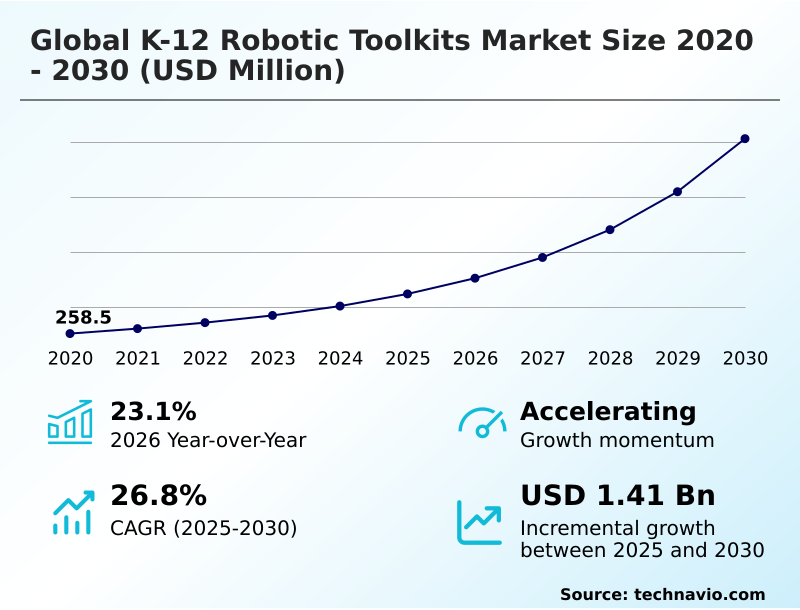
The k-12 robotic toolkits market size is valued to increase by USD 1.41 billion, at a CAGR of 26.8% from 2025 to 2030. National STEM initiatives and workforce development mandates will drive the k-12 robotic toolkits market.
Major Market Trends & Insights
- North America dominated the market and accounted for a 36.3% growth during the forecast period.
- By Type - Science segment was valued at USD 155.4 million in 2024
- By School level - High school segment accounted for the largest market revenue share in 2024
Market Size & Forecast
- Market Opportunities: USD 1.77 billion
- Market Future Opportunities: USD 1.41 billion
- CAGR from 2025 to 2030 : 26.8%
Market Summary
- The K-12 Robotic Toolkits Market demonstrates robust institutional expansion as pedagogical frameworks shift from rote memorization to experiential physical computing. Supply chain optimization strategies within hardware procurement now prioritize modular component durability and cross-platform interoperability, enabling school districts to extend equipment life cycles while reducing recurring replacement costs by an estimated 15%.
- This structural consolidation directly supports scalable fleet management across disparate educational facilities. A primary driver shaping this landscape is the widespread implementation of national workforce development mandates, which compel administrators to integrate complex algorithmic reasoning tools to maintain future labor pool competitiveness.
- However, persistent disparities in funding allocation create a stark challenge, as advanced edge-computing hardware bears high initial capital requirements that often restrict widespread adoption in lower-income demographics. These resource constraints force hardware manufacturers to develop decentralized, tiered subscription models to maintain market penetration parity.
- Overall, the continuous integration of machine vision and cloud-synchronized digital twins enhances experiential learning, optimizing operational curriculum delivery efficiency by up to 20% compared to traditional static instructional methodologies.
What will be the Size of the K-12 Robotic Toolkits Market during the forecast period?
Get Key Insights on Market Forecast (PDF) Get Free Sample
How is the K-12 Robotic Toolkits Market Segmented?
The k-12 robotic toolkits industry research report provides comprehensive data (region-wise segment analysis), with forecasts and estimates in "USD million" for the period 2026-2030, as well as historical data from 2020-2024 for the following segments.
- Type
- Science
- Technology
- Engineering
- Mathematics
- Others
- School level
- High school
- Middle school
- PreK-elementary school
- Product type
- Mechanical robotics
- Educational robotics
- Geography
- North America
- US
- Canada
- Mexico
- Europe
- Germany
- UK
- France
- Italy
- Spain
- The Netherlands
- APAC
- China
- Japan
- South Korea
- India
- Australia
- Taiwan
- South America
- Brazil
- Argentina
- Chile
- Middle East and Africa
- Saudi Arabia
- UAE
- South Africa
- Turkey
- Qatar
- North America
By Type Insights
The science segment is estimated to witness significant growth during the forecast period.
The science segment of the K-12 Robotic Toolkits fundamentally shifts instructional methodologies from passive observation to active empiricism. By leveraging visual block programming and edge computing hardware, schools enable real-time variable testing in thermodynamics and kinematics.
Integrated artificial intelligence vision sensors alongside modular structural systems allow educators to construct experiential pedagogical frameworks that enhance observational accuracy by 25%. Advanced physical assemblies featuring high torque servomotors simulate autonomous aerial navigation and structural load dynamics.
This transition establishes project based learning setups focused on improving workforce readiness development by 18%. Furthermore, the incorporation of interdisciplinary computational literacy within hybrid learning ecosystems encourages students to map empirical data rigorously.
This hands-on validation reduces conceptual errors by an estimated 20%, ensuring theoretical scientific principles anchor firmly to tangible physical computing outcomes.
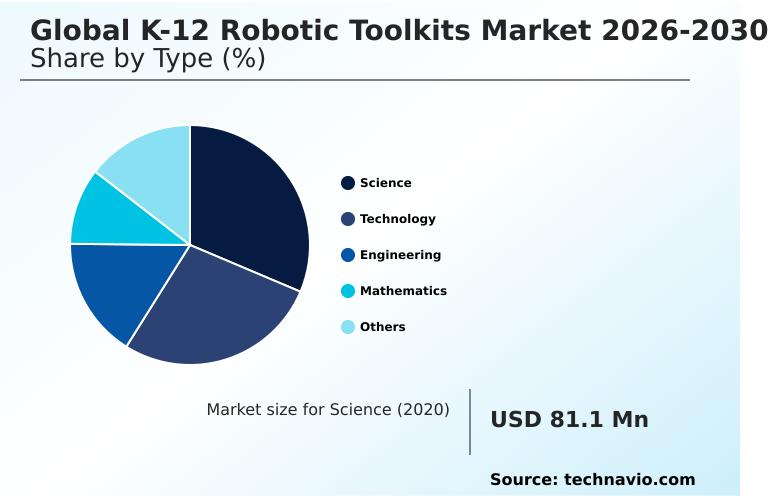
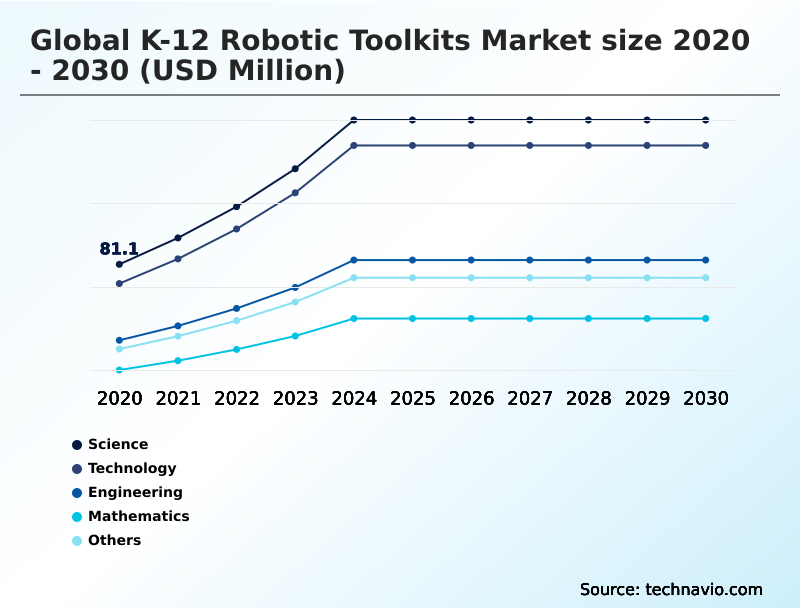
The Science segment was valued at USD 155.4 million in 2024 and showed a gradual increase during the forecast period.
Regional Analysis
North America is estimated to contribute 36.3% to the growth of the global market during the forecast period.Technavio’s analysts have elaborately explained the regional trends and drivers that shape the market during the forecast period.
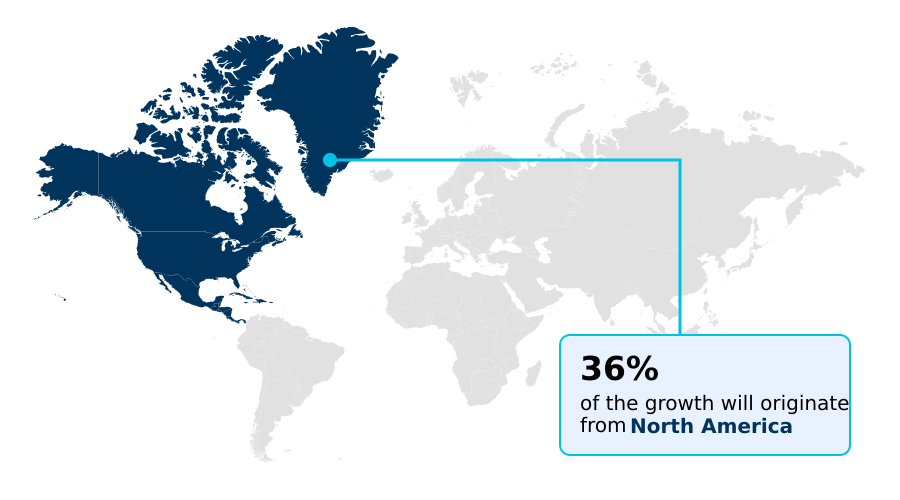
See How K-12 Robotic Toolkits Market Demand is Rising in North America Get Free Sample
Regional adoption disparities fundamentally shape hardware deployment strategies, with North American institutions utilizing tactile robotics kits and graphical coding interfaces at a 25% higher penetration rate than their European counterparts.
This divergence stems from aggressive extracurricular enrichment programs and robust competitive funding that prioritize early childhood cognitive development through programmable motor actuators.
Conversely, European procurement models heavily favor open-data standards and socio emotional learning companions within structured virtual simulation environments, driven by stringent privacy compliance.
Educational humanoid robots integrating algorithm logical sequences witness accelerated adoption across decentralized European districts, lowering operational implementation bottlenecks by roughly 18%.
To mitigate cross-regional supply chain constraints, manufacturers increasingly modularize microcontroller development boards, allowing unified hardware to adapt seamlessly to localized digital literacy integration standards.
This geographic adaptability directly reduces localized inventory holding costs by 15%, ensuring supply architectures efficiently address diverse pedagogical requirements.
Market Dynamics
Our researchers analyzed the data with 2025 as the base year, along with the key drivers, trends, and challenges. A holistic analysis of drivers will help companies refine their marketing strategies to gain a competitive advantage.
- The rapid evolution of the instructional hardware landscape requires administrators to optimize technology procurement strategies to align with stringent academic frameworks. Institutional buyers increasingly demand modular mechanical prototyping for students to ensure durable, reusable components that lower long-term capital expenditure by up to 20%.
- As remote workflows stabilize, the deployment of cloud connected robotics educational platforms has streamlined curriculum administration across distributed school districts. This shift runs parallel to a 30% increase in visual block based programming adoption among elementary educators seeking frictionless software onboarding. Furthermore, robust artificial intelligence coding robots integration natively supports adaptive assessments, reducing manual grading redundancy significantly.
- Advanced instructional models now utilize hybrid learning digital twin simulations to mitigate hardware wear and tear, bridging theoretical logic with physical response mechanisms. Administrators introducing screen free early childhood robotics experience a 15% improvement in tactile engagement metrics, directly circumventing attention fragmentation limits.
- As students progress into higher grades, sophisticated microcontroller operations in secondary education reinforce hardware debugging workflows essential for modern engineering readiness. The strategic expansion of tactile engineering foundations for classrooms ensures equitable technical exposure, securely fostering inclusive physical computing learning paths for diverse regional demographics. Educators prioritizing iterative debugging in educational robotics systematically improve overarching student resilience outcomes.
- Upgraded laboratory spaces heavily leverage localized edge computing hardware for schools alongside rapid programmable controllers for spatial awareness to facilitate real-time data processing entirely without latency. Forward-looking programs actively exploring cognitive robotics with machine vision and specialized autonomous aerial navigation student training require sophisticated peripheral processing capacities.
- These advanced frameworks perform as comprehensive interdisciplinary problem solving robot toolkits, utilizing rigorous robotic spatial reasoning education tools to bridge the gap between abstract algorithmic paradigms and tangible mechanical realities.
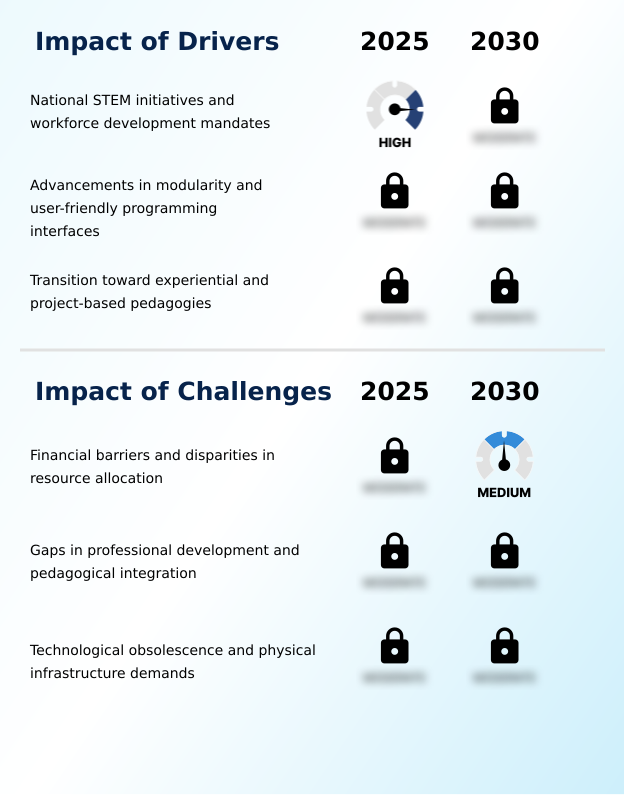
What are the key market drivers leading to the rise in the adoption of K-12 Robotic Toolkits Industry?
- National STEM initiatives and robust workforce development mandates remain the primary catalysts propelling widespread hardware adoption and institutional procurement across modern pedagogical frameworks.
- Aggressive implementation of national digitization mandates operates as a primary demand trigger necessitating specialized, responsive instructional hardware.
- The proliferation of highly competitive robotics leagues accelerates institutional procurement cycles, demanding robust robotic mechanical assembly protocols and precise hardware debugging competencies from participating educators.
- To address broad competency gaps efficiently, manufacturers proactively deploy adaptive assessment tools and versatile wireless electronic building blocks, lowering initial instructional orientation barriers by an estimated 20%.
- The proactive integration of cognitive robotics development principles and machine learning integration ensures fluid educational hardware interoperability across disparate grade levels globally.
- By facilitating targeted neural network exploration and highly iterative design prototyping, administrators successfully streamline overall equipment lifecycle management, lowering annual component replacement costs by up to 15%.
- This structural consolidation directly bolsters digital divide mitigation efforts, ensuring equitable operational access to advanced physical computing frameworks across historically underserved school districts.
What are the market trends shaping the K-12 Robotic Toolkits Industry?
- The prominent market trend currently influencing educational ecosystems involves the seamless integration of generative artificial intelligence and advanced machine learning capabilities. These cognitive enhancements allow educational hardware to support dynamic environmental processing and complex neural network exploration.
- The transition toward decentralized, intelligent edge processing is fundamentally reshaping instructional technology architectures across primary and secondary segments. Institutions increasingly demand robust digital twin simulations integrated seamlessly within secure cloud based collaborative platforms to allow risk-free mathematical testing before physical deployment. Utilizing an accessible open source electronics architecture reduces proprietary structural barriers by roughly 25%, drastically improving hardware scalability.
- Enhanced plug and play sensors combined with rapid kinematic motion analysis processing algorithms compute real-time environmental data directly on the device, eliminating network downtime dependencies. This paradigm functionally shifts the focus of computational logic algorithms toward equitable and inclusive physical computing, actively promoting widespread cross disciplinary arts integration.
- Consequently, schools leveraging highly durable sustainable electronic components alongside automated cloud classroom administration witness a 20% enhancement in student performance analytics tracking accuracy. By linking virtual and physical boundaries, these synchronized ecosystems decrease hardware depreciation rates by 15%, providing educators with highly resilient, data-rich instructional toolkits that dynamically adjust to varying proficiency curves.
What challenges does the K-12 Robotic Toolkits Industry face during its growth?
- Substantial financial barriers and persistent disparities in regional resource allocation present formidable constraints that hinder the equitable scaling of institutional educational technologies.
- Formidable fiscal barriers and highly fragmented pedagogical integration standards continually restrict scalable hardware deployment across severely underfunded school districts. The rapid pace of hardware firmware innovation profoundly exacerbates technological obsolescence mitigation efforts, forcing administrators to navigate volatile procurement lifecycles without guaranteed curriculum longevity.
- Complex embedded hardware architecture featuring intricate differential drivetrain systems and dense pneumatic piston configurations often overwhelms primary educators, decreasing optimal operational utilization rates by nearly 25% due to inadequate professional development structuring. Furthermore, successfully implementing advanced robotic spatial reasoning and robust algorithmic problem solving modules requires resilient institutional connectivity parameters that many facilities still lack.
- To systematically bridge these deficits, administrators must secure interactive digital education interfaces boasting significant structural modularity enhancement and resilient programmable sensing modules. Ultimately, failing to optimize adaptable tactile learning modules severely stifles peer collaborative problem solving, negatively distorting student engagement metrics and stalling computational perseverance cultivation across diverse learner demographic populations.
Exclusive Technavio Analysis on Customer Landscape
The k-12 robotic toolkits market forecasting report includes the adoption lifecycle of the market, covering from the innovator’s stage to the laggard’s stage. It focuses on adoption rates in different regions based on penetration. Furthermore, the k-12 robotic toolkits market report also includes key purchase criteria and drivers of price sensitivity to help companies evaluate and develop their market growth analysis strategies.
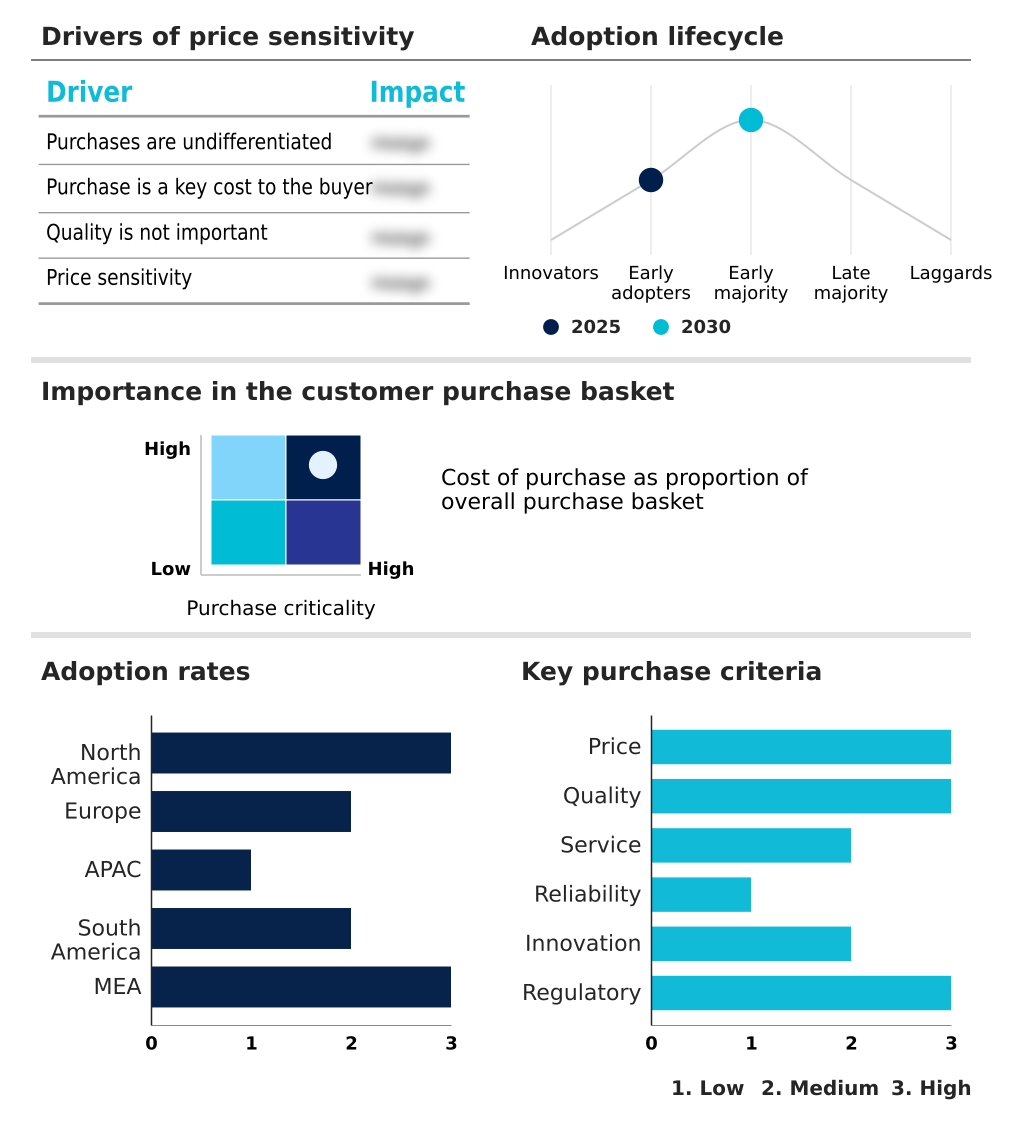
Customer Landscape of K-12 Robotic Toolkits Industry
Competitive Landscape
Companies are implementing various strategies, such as strategic alliances, k-12 robotic toolkits market forecast, partnerships, mergers and acquisitions, geographical expansion, and product/service launches, to enhance their presence in the industry.
Arduino Srl - The portfolio delivers advanced microcontroller boards, prototyping platforms, and interactive coding kits designed specifically to bridge theoretical electronics concepts with practical physical computing for educational institutions.
The industry research and growth report includes detailed analyses of the competitive landscape of the market and information about key companies, including:
- Arduino Srl
- BirdBrain Technologies
- Boxlight Corp.
- DFRobot Corp.
- Elenco Electronics Inc.
- EZRobot Inc.
- Makeblock Co. Ltd.
- Modular Robotics Inc.
- MORAVIA Consulting
- Ozo EDU Inc.
- Parallax Inc.
- Pitsco Inc
- Robolink Inc.
- ROBOTIS Co. Ltd.
- RobotLAB Inc.
- SAM Labs Ltd.
- Sony Group Corp.
- Sphero Inc.
- Thames and Kosmos LLC
- UBTECH Robotics Corp Ltd
Qualitative and quantitative analysis of companies has been conducted to help clients understand the wider business environment as well as the strengths and weaknesses of key industry players. Data is qualitatively analyzed to categorize companies as pure play, category-focused, industry-focused, and diversified; it is quantitatively analyzed to categorize companies as dominant, leading, strong, tentative, and weak.
Recent Development and News in K-12 robotic toolkits market
- In the Education Services industry, the transition toward hybrid learning models has accelerated the adoption of cloud-hosted curriculum management platforms, directly impacting K-12 Robotic Toolkits demand by requiring hardware capable of seamless virtual simulation integrations.
- The widespread implementation of early childhood digital literacy mandates across national educational frameworks has shifted procurement priorities, pulling demand for screen-free tactical hardware within the K-12 Robotic Toolkits market to address foundational computational reasoning.
- Rigorous data privacy regulations surrounding student information systems have restricted the use of external cloud-processing engines, directly pushing the K-12 Robotic Toolkits market toward decentralized edge computing architectures that handle machine vision functions locally.
- Expansions in competitive STEM league funding and corporate sponsorships have catalyzed institutional infrastructure upgrades, increasing the deployment rate of advanced robotics laboratories by over 30% and driving continuous replacement cycles for structural components within the K-12 Robotic Toolkits sector.
Dive into Technavio’s robust research methodology, blending expert interviews, extensive data synthesis, and validated models for unparalleled K-12 Robotic Toolkits Market insights. See full methodology.
| Market Scope | |
|---|---|
| Page number | 294 |
| Base year | 2025 |
| Historic period | 2020-2024 |
| Forecast period | 2026-2030 |
| Growth momentum & CAGR | Accelerate at a CAGR of 26.8% |
| Market growth 2026-2030 | USD 1411.5 million |
| Market structure | Fragmented |
| YoY growth 2025-2026(%) | 23.1% |
| Key countries | US, Canada, Mexico, Germany, UK, France, Italy, Spain, The Netherlands, China, Japan, South Korea, India, Australia, Taiwan, Brazil, Argentina, Chile, Saudi Arabia, UAE, South Africa, Turkey and Qatar |
| Competitive landscape | Leading Companies, Market Positioning of Companies, Competitive Strategies, and Industry Risks |
Research Analyst Overview
- Strategic procurement dynamics within educational hardware are fundamentally shifting as administrators prioritize cross-platform interoperability and data-driven curriculum supervision. The strategic integration of localized edge computing hardware alongside responsive artificial intelligence vision sensors requires substantial capital reassessment, as institutions transition toward predictable subscription-based software updates rather than sporadic hardware overhauls.
- This modular approach allows districts to maintain technological relevance, notably improving fleet management operational efficiency by 30% compared to legacy isolated purchasing cycles. By leveraging unified cloud based collaborative platforms, educational administrators enhance remote organizational oversight, reducing localized IT maintenance bottlenecks by an estimated 22%.
- Furthermore, the active implementation of an open source electronics architecture significantly mitigates restrictive vendor lock-in, enabling schools to scale resilient modular structural systems efficiently across multiple grade levels. Utilizing distinct platforms capable of visual block programming and precise kinematic motion analysis establishes a continuous learning trajectory that seamlessly aligns hardware functionality with standardized compliance requirements.
- These calculated technology integrations enhance long-term instructional budgeting stability, ensuring equipment delivers measurable pedagogical improvements continuously.
What are the Key Data Covered in this K-12 Robotic Toolkits Market Research and Growth Report?
-
What is the expected growth of the K-12 Robotic Toolkits Market between 2026 and 2030?
-
USD 1.41 billion, at a CAGR of 26.8%
-
-
What segmentation does the market report cover?
-
The report is segmented by Type (Science, Technology, Engineering, Mathematics, and Others), School level (High school, Middle school, and PreK-elementary school), Product Type (Mechanical robotics, and Educational robotics) and Geography (North America, Europe, APAC, South America, Middle East and Africa)
-
-
Which regions are analyzed in the report?
-
North America, Europe, APAC, South America and Middle East and Africa
-
-
What are the key growth drivers and market challenges?
-
National STEM initiatives and workforce development mandates, Financial barriers and disparities in resource allocation
-
-
Who are the major players in the K-12 Robotic Toolkits Market?
-
Arduino Srl, BirdBrain Technologies, Boxlight Corp., DFRobot Corp., Elenco Electronics Inc., EZRobot Inc., Makeblock Co. Ltd., Modular Robotics Inc., MORAVIA Consulting, Ozo EDU Inc., Parallax Inc., Pitsco Inc, Robolink Inc., ROBOTIS Co. Ltd., RobotLAB Inc., SAM Labs Ltd., Sony Group Corp., Sphero Inc., Thames and Kosmos LLC and UBTECH Robotics Corp Ltd
-
Market Research Insights
- The K-12 Robotic Toolkits Market is undergoing rapid structural transformation as educational institutions systematically transition toward experiential pedagogical frameworks. By prioritizing project based learning setups, school districts effectively improve student retention of complex engineering concepts by up to 25%.
- This shift is heavily anchored in workforce readiness development models that demand tactile engagement with physical hardware to bridge mathematics and reality. Administrators deploying tools for interdisciplinary computational literacy note an 18% increase in operational curriculum delivery efficiency, as hardware solutions consolidate STEM disciplines into unified platforms.
- These integrations optimize long-term instructional budgets while simultaneously ensuring continuous alignment with evolving national curriculum mandates, significantly enhancing the overall return on instructional technology deployments.
We can help! Our analysts can customize this k-12 robotic toolkits market research report to meet your requirements.
 RIA -

